3. Check Response Functions#
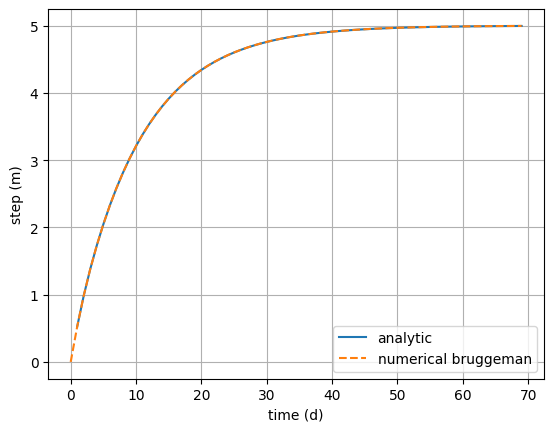
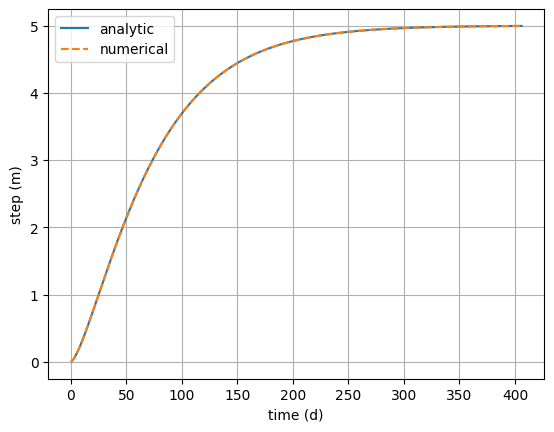
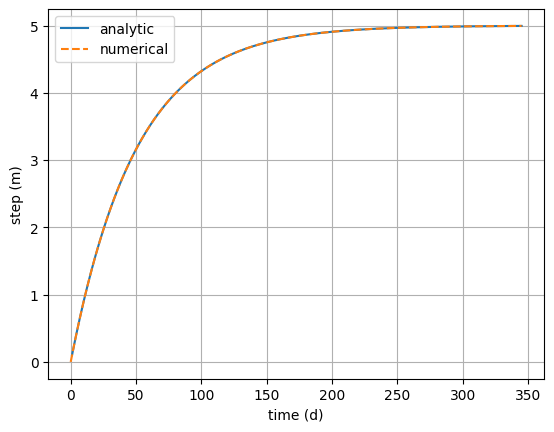
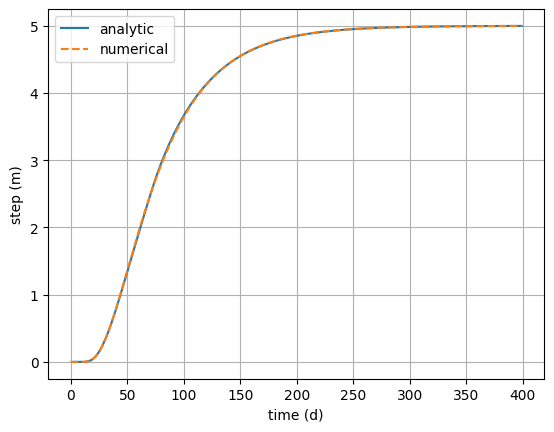
This notebooks checks the step response functions by numerically integrating the impulse response functions.
[1]:
import numpy as np
import matplotlib.pyplot as plt
from scipy.integrate import quad
import pastas as ps
3.1. Gamma#
[2]:
ps.Gamma.impulse
[2]:
[3]:
A = 5
n = 1.5
a = 50
p = [A, n, a]

gamma = ps.Gamma()
tmax = gamma.get_tmax(p)
t = np.arange(0, tmax)

step = gamma.step(p)
stepnum = np.zeros(len(t))
for i in range(1, len(t)):
    stepnum[i] = quad(gamma.impulse, 0, t[i], args=(p))[0]
[4]:
plt.plot(t[1:], step, label="analytic")
plt.plot(t, stepnum, "--", label="numerical")
plt.xlabel("time (d)")
plt.ylabel("step (m)")
plt.grid()
_ = plt.legend()  # try to show figure in readthedocs
3.2. Exponential#
[5]:
ps.Exponential.impulse
[5]:
[6]:
A = 5
a = 50
p = [A, a]

exponential = ps.Exponential()
tmax = exponential.get_tmax(p)
t = np.arange(0, tmax)

step = exponential.step(p)
stepnum = np.zeros(len(t))
for i in range(1, len(t)):
    stepnum[i] = quad(exponential.impulse, 0, t[i], args=(p))[0]
[7]:
plt.plot(t[1:], step, label="analytic")
plt.plot(t, stepnum, "--", label="numerical")
plt.xlabel("time (d)")
plt.ylabel("step (m)")
plt.grid()
_ = plt.legend()  # try to show figure in readthedocs
3.3. Hantush#
[8]:
ps.Hantush.impulse
[8]:
[9]:
A = 5
a = 50
b = 2
p = [A, a, b]

hantush = ps.Hantush()
tmax = hantush.get_tmax(p)
t = np.arange(0, tmax)

step = hantush.step(p)
stepnum = np.zeros(len(t))
for i in range(1, len(t)):
    stepnum[i] = quad(hantush.impulse, 0, t[i], args=(p))[0]
[10]:
plt.plot(t[1:], step, label="analytic")
plt.plot(t, stepnum, "--", label="numerical")
plt.xlabel("time (d)")
plt.ylabel("step (m)")
plt.grid()
_ = plt.legend()  # try to show figure in readthedocs
3.4. Polder#
[11]:
ps.Polder.impulse
[11]:
[12]:
A = 5
a = 100
b = 0.25
p = [A, a, b]

polder = ps.Polder()
tmax = polder.get_tmax(p)
t = np.arange(0, tmax)

step = polder.step(p)
stepnum = np.zeros(len(t))
for i in range(1, len(t)):
    stepnum[i] = quad(polder.impulse, 0, t[i], args=(p))[0]
[13]:
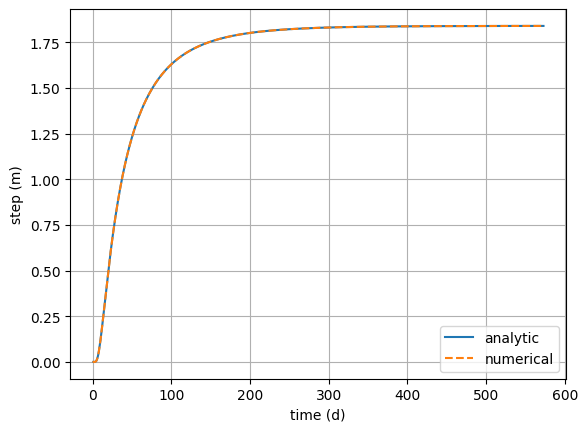
plt.plot(t[1:], step, label="analytic")
plt.plot(t, stepnum, "--", label="numerical")
plt.xlabel("time (d)")
plt.ylabel("step (m)")
plt.grid()
_ = plt.legend()  # try to show figure in readthedocs
3.5. Four-parameter function#
[14]:
ps.FourParam.impulse
[14]:
[15]:
A = 1  # impulse response implemented for A=1 only
n = 1.5
a = 50
b = 10
p = [A, n, a, b]

fourparam = ps.FourParam(quad=False)  # use simple integration
tmax = fourparam.get_tmax(p)
t = np.arange(0, tmax)

step = fourparam.step(p)
stepnum = np.zeros(len(t))
for i in range(1, len(t)):
    stepnum[i] = quad(fourparam.impulse, 0, t[i], args=(p))[0]
stepnum = (
    stepnum / quad(fourparam.impulse, 0, np.inf, args=p)[0]
)  # four param is scaled at the end
[16]:
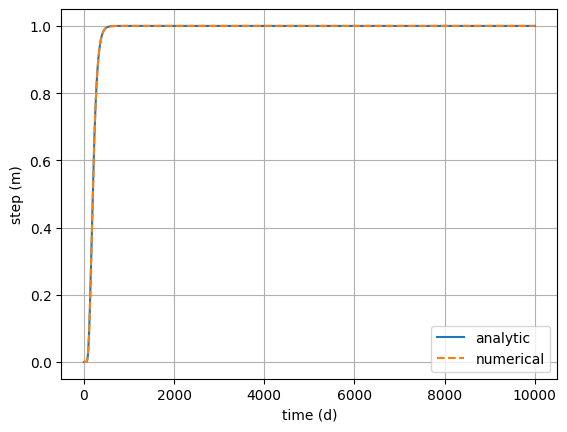
plt.plot(t[1:], step, label="analytic")
plt.plot(t, stepnum, "--", label="numerical")
plt.xlabel("time (d)")
plt.ylabel("step (m)")
plt.grid()
_ = plt.legend()  # try to show figure in readthedocs
3.6. Double exponential function#
[17]:
ps.DoubleExponential.impulse
[17]:
[18]:
A = 5  # impulse response implemented for A=1 only
a = 10
b = 50
f = 0.4
p = [A, f, a, b]

doubexp = ps.DoubleExponential()
tmax = doubexp.get_tmax(p)
t = np.arange(0, tmax)

step = doubexp.step(p)
stepnum = np.zeros(len(t))
for i in range(1, len(t)):
    stepnum[i] = quad(doubexp.impulse, 0, t[i], args=(p))[0]
[19]:
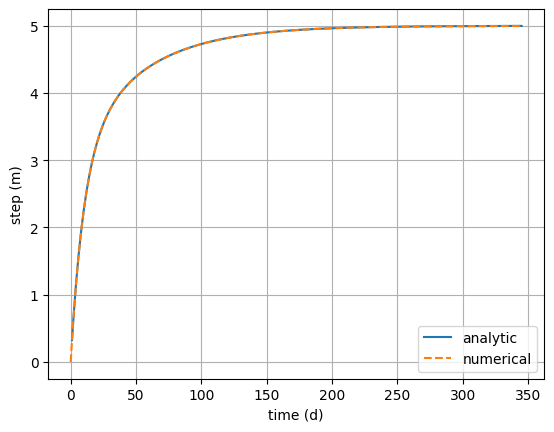
plt.plot(t[1:], step, label="analytic")
plt.plot(t, stepnum, "--", label="numerical")
plt.xlabel("time (d)")
plt.ylabel("step (m)")
plt.grid()
_ = plt.legend()  # try to show figure in readthedocs
3.7. Kraijenhoff#
3.7.1. Kraijenhoff van de Leur#
3.7.1.1. Impulse Response#
from A study of non-steady groundwater flow with special reference to a reservoir-coefficient (1958) formula 2
$ \theta`(t) = :nbsphinx-math:frac{4N}{pi S}` \sum_{n=1,3,5…}^:nbsphinx-math:infty `:nbsphinx-math:left`( \frac{1}{n} \exp{\left( {-n^2\frac{\pi^2T}{SL^2} t} \right)} \sin `:nbsphinx-math:left`(\frac{n\pi x}{L}\right) \right) $
3.7.1.2. Step Response#
The step response is obtained by taking the integral of the impulse response function
$ \Theta`(t) = :nbsphinx-math:frac{4 N}{pi S}` \sum_{n=1,3,5…}^:nbsphinx-math:infty `:nbsphinx-math:frac{1}{n^3}` \left`(:nbsphinx-math:frac{SL^2}{pi^2 T}` - \frac{SL^2}{\pi^2 T} \exp\left`(-n^2:nbsphinx-math:frac{pi^2T}{SL^2}`t:nbsphinx-math:right):nbsphinx-math:right) \sin `:nbsphinx-math:left`(\frac{n\pi x}{L}\right) $
$ \Theta`(t) = :nbsphinx-math:frac{4 N L^2}{pi^3 T}` \sum_{n=1,3,5…}^:nbsphinx-math:infty `:nbsphinx-math:frac{1}{n^3}` \left`(1 - :nbsphinx-math:exp`:nbsphinx-math:left`(-n^2:nbsphinx-math:frac{pi^2T}{SL^2}`t:nbsphinx-math:right):nbsphinx-math:right) \sin `:nbsphinx-math:left`(\frac{n\pi x}{L}\right)$
And \(\sum_{n=1,3,5...}^\infty n = \sum_{n=0}^\infty (2n+1)\) gives:
$ \Theta`(t) = :nbsphinx-math:frac{4 N L^2}{pi^3 T}` \sum_{n=0}^:nbsphinx-math:infty `:nbsphinx-math:frac{1}{(2n+1)^3}` \left`(1 - :nbsphinx-math:exp`:nbsphinx-math:left`(-(2n+1)^2:nbsphinx-math:frac{pi^2T}{SL^2}`t):nbsphinx-math:right):nbsphinx-math:right) \sin `:nbsphinx-math:left`(\frac{(2n+1)\pi x}{L}\right)$
Kraijenhoff van de Leur takes \(\frac{x}{L}=\frac{1}{2}\) as the middle of the domain.
3.7.2. Bruggeman#
from Analytical Solutions of Geohydrological Problems (1999) formula 133.15
3.7.2.1. Step Response#
$ \Theta`(t) = :nbsphinx-math:frac{-N}{2T}`:nbsphinx-math:left`(x^2 - :nbsphinx-math:frac{1}{4}`L^2:nbsphinx-math:right) - \frac{4NL^2}{\pi^3T} \sum_{n=0}^:nbsphinx-math:infty \frac{(-1)^n}{(2n + 1)^3} \cos\left`(:nbsphinx-math:frac{(2n+1)pi x}{L}`:nbsphinx-math:right) \exp\left`(-:nbsphinx-math:frac{(2n+1)^2pi^2 T}{SL^2}`t:nbsphinx-math:right) $
$ \Theta`(t) = :nbsphinx-math:frac{-NL^2}{2T}`:nbsphinx-math:left`(:nbsphinx-math:left`(\frac{x}{L}\right)^2 - \frac{1}{4}\right) - \frac{4NL^2}{\pi^3T} \sum_{n=0}^:nbsphinx-math:infty \frac{(-1)^n}{(2n + 1)^3} \exp\left`(-:nbsphinx-math:frac{(2n+1)^2pi^2 T}{SL^2}`t:nbsphinx-math:right) \cos\left`(:nbsphinx-math:frac{(2n+1)pi x}{L}`:nbsphinx-math:right) $
$ \Theta`(t) = :nbsphinx-math:frac{-NL^2}{2T}`:nbsphinx-math:left`(:nbsphinx-math:left`(\frac{x}{L}\right)^2 - \tfrac{1}{4}\right) \left`(1 - :nbsphinx-math:frac{8}{pi^3 left(frac{1}{4} - left(frac{x}{L}right)^2right)}` \sum_{n=0}^:nbsphinx-math:infty \frac{(-1)^n}{(2n + 1)^3} \exp\left`(-:nbsphinx-math:frac{(2n+1)^2pi^2 T}{SL^2}`t:nbsphinx-math:right) \cos\left`(:nbsphinx-math:frac{(2n+1)pi x}{L}`:nbsphinx-math:right) \right) $
Note that \(x=0\) is the middle of the domain for Bruggeman.
3.7.3. Pastas Implementation#
In Pastas the Bruggeman response function is computed and the parameters are transformed to:
Scale parameter (such that the gain is always \(A\)):
\(A = \frac{-NL^2}{2T}\left(\left(\frac{x}{L}\right)^2 - \tfrac{1}{4}\right)\)
Reservoir coefficient (also known as \(j\) in Kraijenhoff):
\(a = \frac{SL^2}{\pi^2 T}\)
Location in the domain:
\(b = \frac{x}{L}\)
Such that the step response becomes:
$ \Theta`(t) = A:nbsphinx-math:left`(1 - \frac{8}{\pi^3(\frac{1}{4} - b^2)} \sum_{n=0}^:nbsphinx-math:infty `:nbsphinx-math:frac{(-1)^n}{(2n+1)^3}` \cos\left`((2n+1):nbsphinx-math:pi b:nbsphinx-math:right`):nbsphinx-math:exp\left`(-:nbsphinx-math:frac{(2n+1)^2t}{a}`:nbsphinx-math:right) \right)$
Taking the derivative gives the impulse response:
[20]:
ps.Kraijenhoff.impulse
[20]:
[21]:
A = 5
a = 10
b = 0.25
p = [A, a, b]

khoff = ps.Kraijenhoff()
tmax = khoff.get_tmax(p)
t = np.arange(0, tmax)

step = khoff.step(p)
stepnum_brug = np.zeros(len(t))

for i in range(1, len(t)):
    stepnum_brug[i] = quad(khoff.impulse, 0, t[i], args=(p))[0]
[22]:
plt.plot(t[1:], step, label="analytic")
plt.plot(t, stepnum_brug, "--", label="numerical bruggeman")
plt.xlabel("time (d)")
plt.ylabel("step (m)")
plt.grid()
_ = plt.legend()  # try to show figure in readthedocs