
Changing response functions#
R.A. Collenteur, University of Graz, 2021
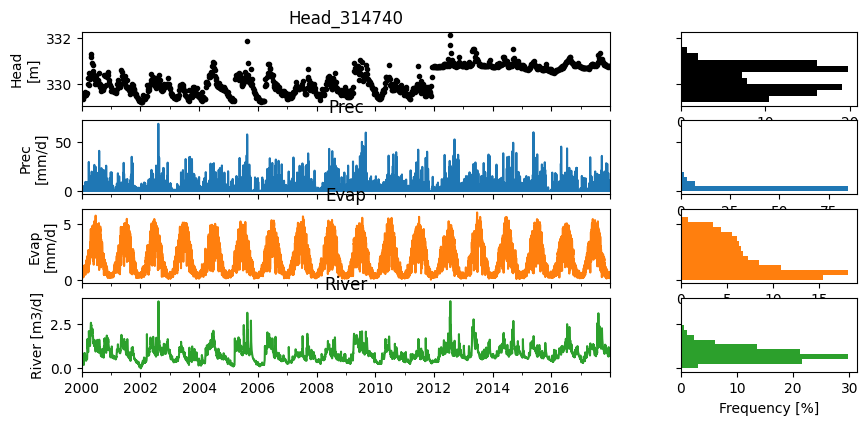
In this notebook the new ChangeModel is tested, based on the work by Obergfjell et al. (2019). The main idea is to apply different response functions for two different periods. As an example we look at the the groundwater levels measured near the river the Mur in Austria, where a dam was recently built.
import matplotlib.pyplot as plt
import numpy as np
import pandas as pd

import pastas as ps

ps.set_log_level("ERROR")
ps.show_versions()
Pastas version: 1.12.0
Python version: 3.11.12
NumPy version: 2.3.4
Pandas version: 2.3.3
SciPy version: 1.16.3
Matplotlib version: 3.10.7
Numba version: 0.62.1
1. Load the data#
prec = pd.read_csv("data_step/prec.csv", index_col=0, parse_dates=True).squeeze()
evap = pd.read_csv("data_step/evap.csv", index_col=0, parse_dates=True).squeeze()
head = pd.read_csv("data_step/head.csv", index_col=0, parse_dates=True).squeeze()
river = pd.read_csv("data_step/river.csv", index_col=0, parse_dates=True).squeeze()
river -= river.min()

axes = ps.plots.series(
    head=head,
    stresses=[prec, evap, river],
    tmin="2000",
    labels=["Head\n[m]", "Prec\n[mm/d]", "Evap\n[mm/d]", "River [m3/d]"],
)
2. The weighting factor#
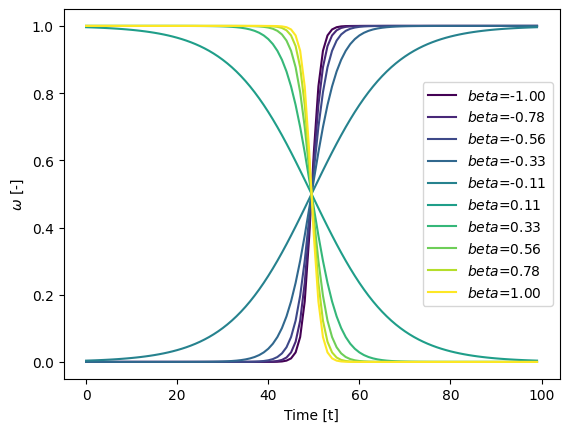
The stress is convolved two times with different response functions. Then, a weighting function is used to add the two contributions together and compute the final contribution.
npoints = 100

tchange = 50 / npoints
t = np.linspace(0, 1, npoints)
color = plt.cm.viridis(np.linspace(0, 1, 10))

for beta, c in zip(np.linspace(-1, 1, 10), color):
    beta1 = beta * npoints
    omega = 1 / (np.exp(beta1 * (t - tchange)) + 1)
    plt.plot(omega, color=c, label="$beta$={:.2f}".format(beta))

plt.ylabel("$\omega$ [-]")
plt.xlabel("Time [t]")
plt.legend()
<matplotlib.legend.Legend at 0x7a32c8000d50>
3. Make a model#
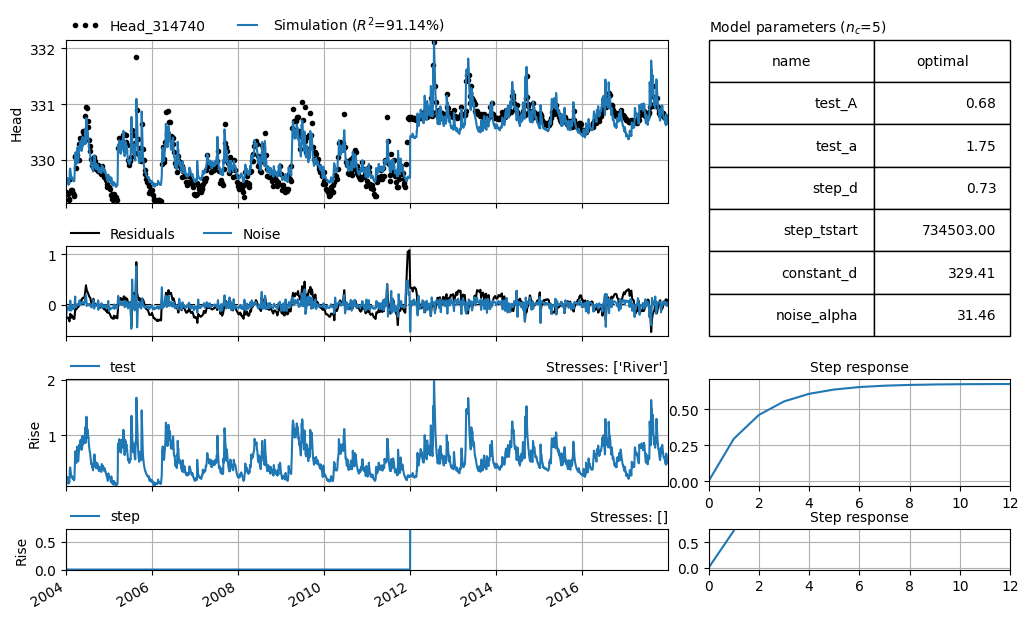
We now make two models:
one model where we assume the response of the heads to the river level remains the same
and one model where the response to the river levels changes.
# Normal Model
ml = ps.Model(head, name="linear")
ml.add_noisemodel(ps.ArNoiseModel())

sm = ps.StressModel(river, ps.Exponential(), name="test")
step = ps.StepModel("2012-01-01", rfunc=ps.One(), name="step")

ml.add_stressmodel([sm, step])
ml.solve(report=False, tmin="2004", tmax="2017-12-31")
ml.plots.results(figsize=(10, 6))

# ChangeModel
ml2 = ps.Model(head, name="linear")
ml2.add_noisemodel(ps.ArNoiseModel())

cm = ps.ChangeModel(
    river,
    ps.Exponential(),
    ps.Exponential(),
    name="test",
    tchange="2012-01-01",
)

ml2.add_stressmodel([cm, step])
ml2.solve(report=False, tmin="2004", tmax="2017-12-31")
ml2.plots.results(figsize=(10, 6));
/home/docs/checkouts/readthedocs.org/user_builds/pastas/envs/v1.12.0/lib/python3.11/site-packages/pastas/stressmodels.py:2113: RuntimeWarning: overflow encountered in exp
  omega = 1 / (np.exp(beta * (t - sigma)) + 1)
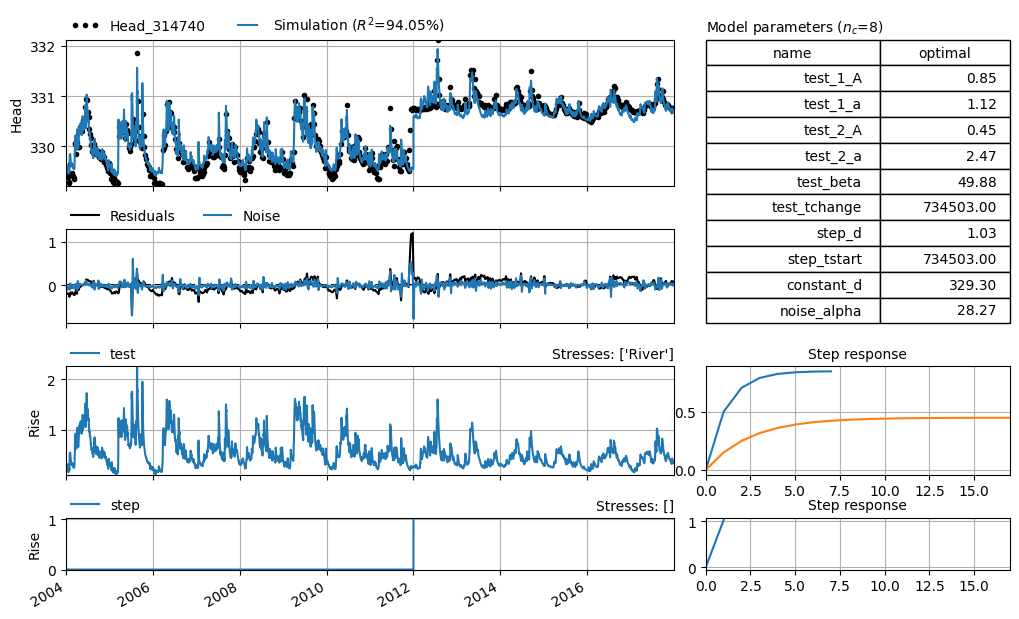
The second model shows a better fit, but also the step trend changed.
print("RMSE for the first model:", ml.stats.rmse().round(2))
print("RMSE for the second model:", ml2.stats.rmse().round(2))
RMSE for the first model: 0.17
RMSE for the second model: 0.14
ml2.parameters
| initial | pmin | pmax | vary | name | dist | stderr | optimal | |
|---|---|---|---|---|---|---|---|---|
| test_1_A | 1.00000 | 1.000000e-05 | 100.0 | True | test | uniform | 0.020368 | 0.851246 |
| test_1_a | 10.00000 | 1.000000e-02 | 10000.0 | True | test | uniform | 0.097426 | 1.124817 |
| test_2_A | 1.00000 | 1.000000e-05 | 100.0 | True | test | uniform | 0.030528 | 0.449466 |
| test_2_a | 10.00000 | 1.000000e-02 | 10000.0 | True | test | uniform | 0.298076 | 2.466727 |
| test_beta | 0.00000 | -inf | inf | True | test | uniform | 14.187024 | 49.878043 |
| test_tchange | 734503.00000 | 6.124110e+05 | 825914.0 | False | test | uniform | NaN | 734503.000000 |
| step_d | 1.00000 | NaN | NaN | True | step | uniform | 0.041485 | 1.029065 |
| step_tstart | 734503.00000 | 6.124110e+05 | 825914.0 | False | step | uniform | NaN | 734503.000000 |
| constant_d | 330.18797 | NaN | NaN | True | constant | uniform | 0.024624 | 329.301849 |
| noise_alpha | 7.00000 | 1.000000e-05 | 5000.0 | True | noise | uniform | 3.737265 | 28.265508 |
4. Compare the response functions#
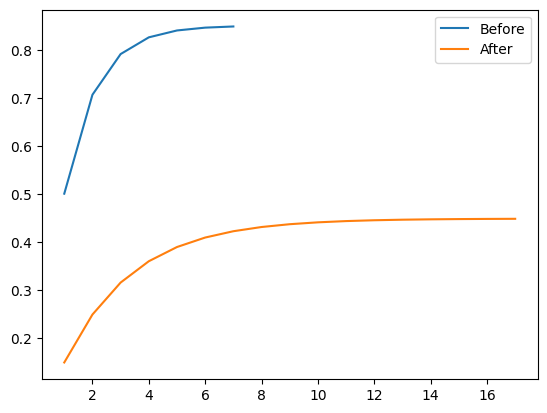
We can also look at the response to the river before and after,
cm_rf1 = cm.rfunc1.step(
    p=ml2.parameters.loc[["test_1_A", "test_1_a"], "optimal"].values
)
cm_rf2 = cm.rfunc2.step(
    p=ml2.parameters.loc[["test_2_A", "test_2_a"], "optimal"].values
)

plt.plot(np.arange(1, len(cm_rf1) + 1), cm_rf1)
plt.plot(np.arange(1, len(cm_rf2) + 1), cm_rf2)

plt.legend(["Before", "After"]);
5. Another way#
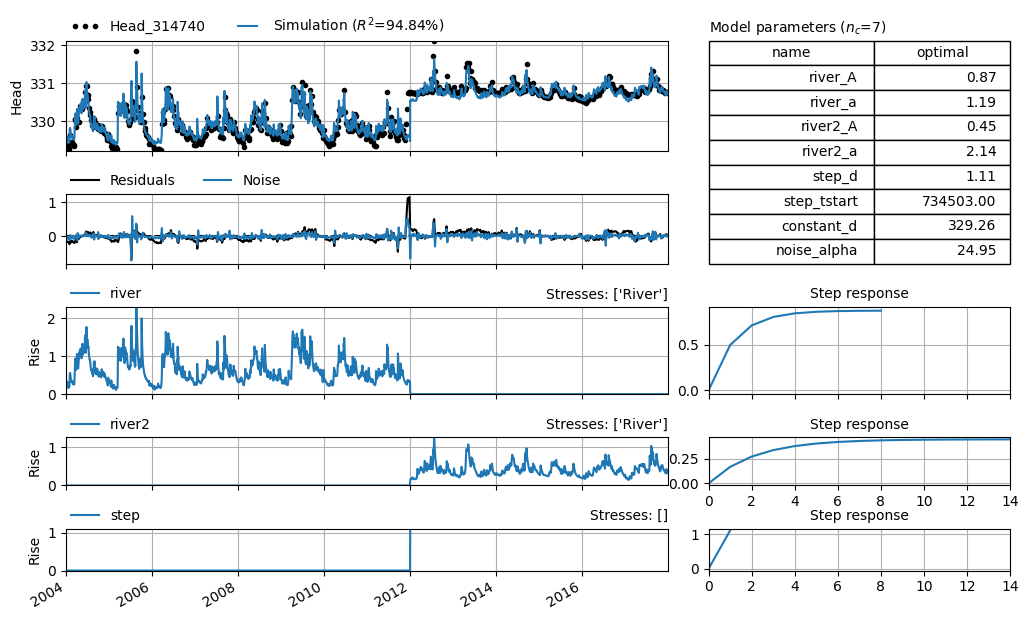
We can also add the stress twice, saving one parameter that needs to be estimated.
ml3 = ps.Model(head, name="linear")
ml3.add_noisemodel(ps.ArNoiseModel())

river1 = river.copy()
river1.loc["2012":] = 0

river2 = river.copy()
river2.loc[:"2011"] = 0

r1 = ps.StressModel(river1, rfunc=ps.Exponential(), name="river")
r2 = ps.StressModel(river2, rfunc=ps.Exponential(), name="river2")
step = ps.StepModel("2012-01-01", rfunc=ps.One(), name="step")

ml3.add_stressmodel([r1, r2, step])
ml3.solve(report=False, tmin="2004", tmax="2017-12-31")
ml3.plots.results(figsize=(10, 6));
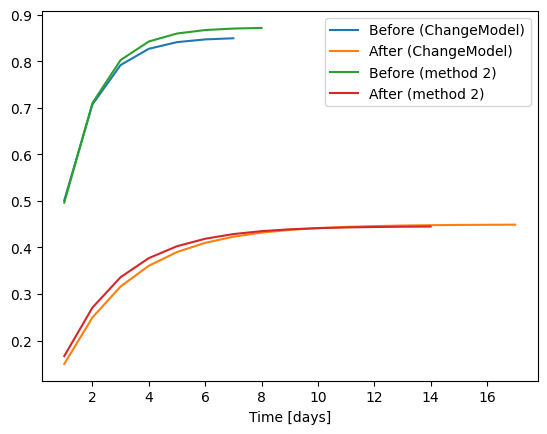
How do the results compare?#
# change model
cm_rf1 = cm.rfunc1.step(
    p=ml2.parameters.loc[["test_1_A", "test_1_a"], "optimal"].values
)
cm_rf2 = cm.rfunc2.step(
    p=ml2.parameters.loc[["test_2_A", "test_2_a"], "optimal"].values
)
plt.plot(np.arange(1, len(cm_rf1) + 1), cm_rf1)
plt.plot(np.arange(1, len(cm_rf2) + 1), cm_rf2)

# 2 stressmodels
ml3.get_step_response("river").plot()
ml3.get_step_response("river2").plot()

plt.legend(
    [
        "Before (ChangeModel)",
        "After (ChangeModel)",
        "Before (method 2)",
        "After (method 2)",
    ]
)
<matplotlib.legend.Legend at 0x7a32bdca76d0>
References#
Obergfell, C., Bakker, M. and Maas, K. (2019), Identification and Explanation of a Change in the Groundwater Regime using Time Series Analysis. Groundwater, 57: 886-894. https://doi.org/10.1111/gwat.12891