
Frequentist uncertainty vs. Bayesian uncertainty analysis#
Mark Bakker, TU Delft & Raoul Collenteur, Eawag, February, 2025
In this notebook, the fit and uncertainty are compared for pastas models solved with least squares (frequentist uncertainty) and with MCMC (Bayesian uncertainty).
Besides Pastas the following Python Packages have to be installed to run this notebook:
import corner
import emcee
import matplotlib.pyplot as plt
import numpy as np
import pandas as pd

import pastas as ps

ps.set_log_level("ERROR")
ps.show_versions()
Pastas version: 1.13.2
Python version: 3.11.12
NumPy version: 2.3.5
Pandas version: 2.3.3
SciPy version: 1.17.0
Matplotlib version: 3.10.8
Numba version: 0.63.1
1. A ‘regular’ Pastas Model#
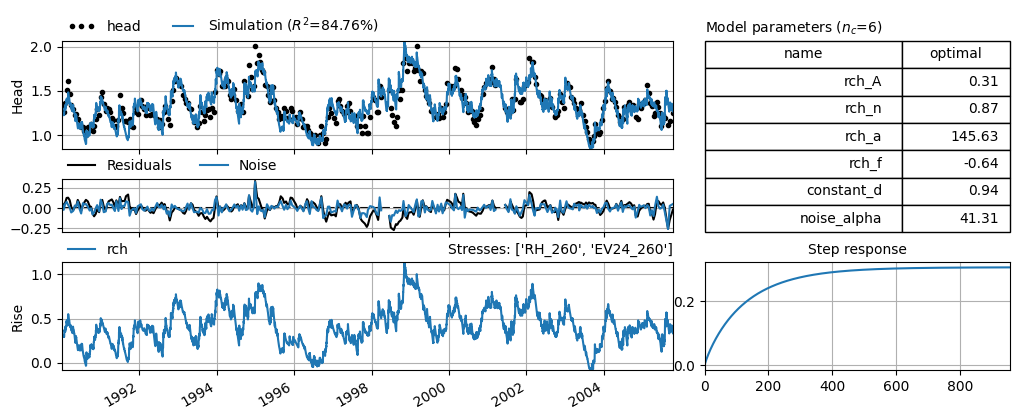
The first step is to create a Pastas Model with a linear RechargeModel and a Gamma response function to simulate the effect of precipitation and evaporation on the heads. The AR1 noise model is used. We first estimate the model parameters using the standard least-squares approach.
head = pd.read_csv(
    "data/B32C0639001.csv", parse_dates=["date"], index_col="date"
).squeeze()
head = head["1990":]  # use data from 1990 on for this example

evap = pd.read_csv("data/evap_260.csv", index_col=0, parse_dates=[0]).squeeze()
rain = pd.read_csv("data/rain_260.csv", index_col=0, parse_dates=[0]).squeeze()

ml1 = ps.Model(head)
ml1.add_noisemodel(ps.ArNoiseModel())

rm = ps.RechargeModel(
    rain, evap, recharge=ps.rch.Linear(), rfunc=ps.Gamma(), name="rch"
)
ml1.add_stressmodel(rm)

ml1.solve()

ax = ml1.plots.results(figsize=(10, 4))
Fit report head                     Fit Statistics
==================================================
nfev     31                     EVP          84.76
nobs     351                    R2            0.85
noise    True                   RMSE          0.08
tmin     1990-01-02 00:00:00    AICc      -1976.57
tmax     2005-10-14 00:00:00    BIC       -1953.65
freq     D                      Obj           0.61
freq_obs None                   ___
warmup   3650 days 00:00:00     Interp.         No
solver   LeastSquares           weights        Yes

Parameters (6 optimized)
==================================================
                optimal    initial  vary
rch_A          0.306929   0.198424  True
rch_n          0.873052   1.000000  True
rch_a        145.630892  10.000000  True
rch_f         -0.637841  -1.000000  True
constant_d     0.935046   1.338063  True
noise_alpha   41.305065  15.000000  True
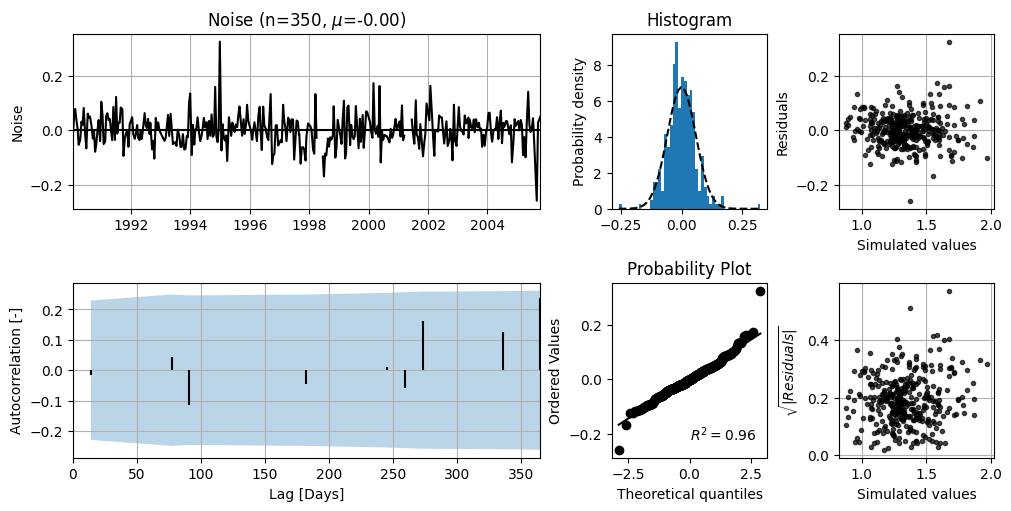
The diagnostics show that the noise meets the statistical requirements for uncertainty analysis reasonably well.
ml1.plots.diagnostics();
The estimated least squares parameters and standard errors are stored for later reference
ls_params = ml1.parameters[["optimal", "stderr"]].copy()
ls_params.rename(columns={"optimal": "ls_opt", "stderr": "ls_sig"}, inplace=True)
ls_params
| ls_opt | ls_sig | |
|---|---|---|
| rch_A | 0.306929 | 0.021354 |
| rch_n | 0.873052 | 0.026222 |
| rch_a | 145.630892 | 18.352602 |
| rch_f | -0.637841 | 0.069333 |
| constant_d | 0.935046 | 0.048544 |
| noise_alpha | 41.305065 | 6.342946 |
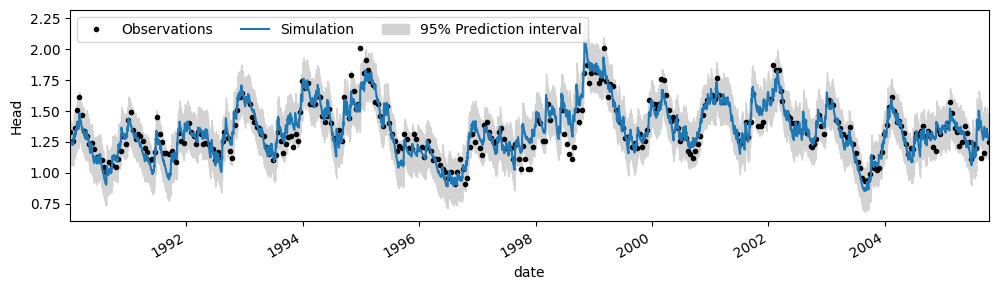
# Compute prediction interval Pastas
pi = ml1.solver.prediction_interval(n=1000)
ax = ml1.plot(figsize=(10, 3))
ax.fill_between(pi.index, pi.iloc[:, 0], pi.iloc[:, 1], color="lightgray")
ax.legend(["Observations", "Simulation", "95% Prediction interval"], ncol=3, loc=2)
pi_pasta = np.mean(pi[0.975] - pi[0.025])
print(f"Mean prediction interval width: {pi_pasta:.3f} m")
print(f"Prediction interval coverage probability: {ps.stats.picp(head, pi): .3f}")
Mean prediction interval width: 0.325 m
Prediction interval coverage probability:  0.946
2. Use the EmceeSolver#
We will now use MCMC to estimate the model parameters and their uncertainties. The EmceeSolve solver wraps the Emcee package, which implements different versions of MCMC. A good understanding of Emcee helps when using this solver, so it comes recommended to check out their documentation as well.
We start by making a pastas model with a linear recharge model and a Gamma response function. No noise model is added, as this is taken care of in the likelihood function. The model is solved using the regular solve (least squares) to have a good estimate of the starting values of the parameters.
ml2 = ps.Model(head)
rm = ps.RechargeModel(
    rain, evap, recharge=ps.rch.Linear(), rfunc=ps.Gamma(), name="rch"
)
ml2.add_stressmodel(rm)
ml2.solve()
Fit report head                     Fit Statistics
==================================================
nfev     14                     EVP          86.58
nobs     351                    R2            0.87
noise    False                  RMSE          0.08
tmin     1990-01-02 00:00:00    AICc      -1797.03
tmax     2005-10-14 00:00:00    BIC       -1777.90
freq     D                      Obj           1.02
freq_obs None                   ___
warmup   3650 days 00:00:00     Interp.         No
solver   LeastSquares           weights        Yes

Parameters (5 optimized)
==================================================
               optimal    initial  vary
rch_A         0.314022   0.198424  True
rch_n         0.800954   1.000000  True
rch_a       235.006908  10.000000  True
rch_f        -0.898115  -1.000000  True
constant_d    1.051880   1.338063  True
To set up the EmceeSolve solver, a number of decisions need to be made:
Select the priors of the parameters
Select a (log) likelihood function
Select the number of steps and thinning
2a. Priors#
The first step is to select the priors of the parameters. This is done by using the ml.set_parameter method and the dist argument (from distribution). Any distribution from scipy.stats can be chosen url, for example uniform, norm, or lognorm. Here, we select normal distributions for the priors. Currently, pastas will use the initial value of the parameter for the loc argument of the distribution (e.g., the mean of a normal distribution), and the stderr as the scale argument (e.g., the standard deviation of a normal distribution). Only for the parameters with a uniform distribution, the pmin and pmax values are used to determine a uniform prior. By default, all parameters are assigned a uniform prior.
# Set the initial parameters to a normal distribution
ml2.parameters["initial"] = ml2.parameters[
    "optimal"
]  # set initial value to the optimal from least squares for good starting point
ml2.parameters["stderr"] = (
    2 * ml2.parameters["stderr"]
)  # this column is used (for now) to set the scale of the normal distribution

for name in ml2.parameters.index:
    ml2.set_parameter(
        name,
        dist="norm",
    )

ml2.parameters
| initial | pmin | pmax | vary | name | dist | stderr | optimal | |
|---|---|---|---|---|---|---|---|---|
| rch_A | 0.198424 | 0.00001 | 19.842364 | True | rch | norm | 0.011471 | 0.314022 |
| rch_n | 1.000000 | 0.10000 | 5.000000 | True | rch | norm | 0.024863 | 0.800954 |
| rch_a | 10.000000 | 0.01000 | 10000.000000 | True | rch | norm | 23.127653 | 235.006908 |
| rch_f | -1.000000 | -2.00000 | 0.000000 | True | rch | norm | 0.053825 | -0.898115 |
| constant_d | 1.338063 | NaN | NaN | True | constant | norm | 0.028972 | 1.051880 |
2b. Create the solver instance#
The next step is to create an instance of the EmceeSolve solver class. At this stage all the settings need to be provided on how the Ensemble Sampler is created (https://emcee.readthedocs.io/en/stable/user/sampler/). Important settings are the nwalkers, the moves, the objective_function. More advanced options are to parallelize the MCMC algorithm (parallel=True), and to set a backend to store the results. Here’s an example:
# Choose the objective function
ln_prob = ps.objfunc.GaussianLikelihoodAr1()

# Create the EmceeSolver with some settings
s = ps.EmceeSolve(
    nwalkers=20,
    moves=emcee.moves.DEMove(),
    objective_function=ln_prob,
    progress_bar=True,
    parallel=False,
)
In the above code we created an EmceeSolve instance with 20 walkers, which take steps according to the DEMove move algorithm (see Emcee docs), and a Gaussian likelihood function that assumes AR1 correlated errors. Different objective functions are available, see the Pastas documentation on the different options.
Depending on the likelihood function, a number of additional parameters need to be inferred. These parameters are not added to the Pastas Model instance, but are available from the solver object. Using the set_parameter method of the solver, these parameters can be changed. In this example where we use the GaussianLikelihoodAr1 function, the \(\sigma^2\) and \(\phi\) are estimated; the unknown standard deviation of the errors and the autoregressive parameter.
s.parameters
| initial | pmin | pmax | vary | stderr | name | dist | |
|---|---|---|---|---|---|---|---|
| ln_var | 0.05 | 1.000000e-10 | 1.00000 | True | 0.01 | ln | uniform |
| ln_phi | 0.50 | 1.000000e-10 | 0.99999 | True | 0.20 | ln | uniform |
sigsq = ml1.noise().std() ** 2
s.set_parameter("ln_var", initial=sigsq, vary=True)
s.parameters.loc["ln_var", "stderr"] = stderr = sigsq / 8
s.parameters
| initial | pmin | pmax | vary | stderr | name | dist | |
|---|---|---|---|---|---|---|---|
| ln_var | 0.00347 | 1.000000e-10 | 1.00000 | True | 0.000434 | ln | uniform |
| ln_phi | 0.50000 | 1.000000e-10 | 0.99999 | True | 0.200000 | ln | uniform |
2c. Run the solver and solve the model#
After setting the parameters and creating a EmceeSolve solver instance we are now ready to run the MCMC analysis. We can do this by running ml.solve. We can pass the same parameters that we normally provide to this method (e.g., tmin or fit_constant). Here we use the initial parameters from our least-square solve, and do not fit a noise model, because we take autocorrelated errors into account through the likelihood function.
All the arguments that are not used by ml.solve, for example steps and tune, are passed on to the run_mcmc method from the sampler (see Emcee docs). The most important is the steps argument, that determines how many steps each of the walkers takes.
# Use the solver to run MCMC
ml2.solve(
    solver=s,
    initial=False,
    tmin="1990",
    steps=1000,
    tune=True,
    report=False,
)
emcee: Exception while calling your likelihood function:
  params: [ 3.09488783e-01  8.04082681e-01  1.89960265e+02 -8.51429199e-01
  1.04164910e+00  4.21385240e-03  6.04493343e-01]
  args: (False, None, None)
  kwargs: {}
  exception:
  0%|          | 0/1000 [00:00<?, ?it/s]
  0%|          | 3/1000 [00:00<00:47, 21.18it/s]
  1%|          | 6/1000 [00:00<00:46, 21.24it/s]
  1%|          | 9/1000 [00:00<00:46, 21.18it/s]
  1%|          | 12/1000 [00:00<00:46, 21.16it/s]
  2%|▏         | 15/1000 [00:00<00:46, 21.25it/s]
  2%|▏         | 18/1000 [00:00<00:46, 21.17it/s]
  2%|▏         | 21/1000 [00:00<00:46, 21.22it/s]
  2%|▏         | 24/1000 [00:01<00:45, 21.30it/s]
  3%|▎         | 27/1000 [00:01<00:45, 21.28it/s]
  3%|▎         | 30/1000 [00:01<00:45, 21.25it/s]
  3%|▎         | 33/1000 [00:01<00:45, 21.25it/s]
  4%|▎         | 36/1000 [00:01<00:45, 21.19it/s]
  4%|▍         | 39/1000 [00:01<00:45, 21.25it/s]
  4%|▍         | 42/1000 [00:01<00:44, 21.32it/s]
  4%|▍         | 45/1000 [00:02<00:44, 21.35it/s]
  5%|▍         | 48/1000 [00:02<00:44, 21.47it/s]
  5%|▌         | 51/1000 [00:02<00:44, 21.51it/s]
  5%|▌         | 54/1000 [00:02<00:44, 21.46it/s]
  6%|▌         | 57/1000 [00:02<00:43, 21.52it/s]
  6%|▌         | 60/1000 [00:02<00:43, 21.49it/s]
  6%|▋         | 63/1000 [00:02<00:43, 21.45it/s]
  7%|▋         | 66/1000 [00:03<00:43, 21.51it/s]
  7%|▋         | 69/1000 [00:03<00:43, 21.47it/s]
  7%|▋         | 72/1000 [00:03<00:43, 21.50it/s]
  8%|▊         | 75/1000 [00:03<00:43, 21.41it/s]
  8%|▊         | 78/1000 [00:03<00:43, 21.38it/s]
  8%|▊         | 81/1000 [00:03<00:42, 21.42it/s]
  8%|▊         | 84/1000 [00:03<00:42, 21.49it/s]
  9%|▊         | 87/1000 [00:04<00:42, 21.51it/s]
  9%|▉         | 90/1000 [00:04<00:42, 21.55it/s]
  9%|▉         | 93/1000 [00:04<00:42, 21.56it/s]
 10%|▉         | 96/1000 [00:04<00:41, 21.55it/s]
 10%|▉         | 99/1000 [00:04<00:41, 21.49it/s]
 10%|█         | 102/1000 [00:04<00:41, 21.42it/s]
 10%|█         | 105/1000 [00:04<00:41, 21.35it/s]
 11%|█         | 108/1000 [00:05<00:41, 21.36it/s]
 11%|█         | 111/1000 [00:05<00:41, 21.39it/s]
 11%|█▏        | 114/1000 [00:05<00:41, 21.39it/s]
 12%|█▏        | 117/1000 [00:05<00:41, 21.32it/s]
 12%|█▏        | 120/1000 [00:05<00:42, 20.95it/s]
 12%|█▏        | 123/1000 [00:05<00:41, 21.05it/s]
 13%|█▎        | 126/1000 [00:05<00:41, 21.21it/s]
 13%|█▎        | 129/1000 [00:06<00:40, 21.26it/s]
 13%|█▎        | 132/1000 [00:06<00:40, 21.34it/s]
 14%|█▎        | 135/1000 [00:06<00:40, 21.36it/s]
 14%|█▍        | 138/1000 [00:06<00:40, 21.41it/s]
 14%|█▍        | 141/1000 [00:06<00:40, 21.38it/s]
 14%|█▍        | 144/1000 [00:06<00:39, 21.46it/s]
 15%|█▍        | 147/1000 [00:06<00:39, 21.43it/s]
 15%|█▌        | 150/1000 [00:07<00:39, 21.42it/s]
 15%|█▌        | 153/1000 [00:07<00:39, 21.43it/s]
 16%|█▌        | 156/1000 [00:07<00:39, 21.37it/s]
 16%|█▌        | 159/1000 [00:07<00:39, 21.32it/s]
 16%|█▌        | 162/1000 [00:07<00:39, 21.31it/s]
 16%|█▋        | 165/1000 [00:07<00:39, 21.21it/s]
 17%|█▋        | 168/1000 [00:07<00:39, 21.29it/s]
 17%|█▋        | 171/1000 [00:08<00:38, 21.29it/s]
 17%|█▋        | 174/1000 [00:08<00:39, 21.13it/s]
 18%|█▊        | 177/1000 [00:08<00:38, 21.25it/s]
 18%|█▊        | 180/1000 [00:08<00:38, 21.37it/s]
 18%|█▊        | 183/1000 [00:08<00:38, 21.42it/s]
 19%|█▊        | 186/1000 [00:08<00:37, 21.43it/s]
 19%|█▉        | 189/1000 [00:08<00:37, 21.40it/s]
 19%|█▉        | 192/1000 [00:08<00:37, 21.39it/s]
 20%|█▉        | 195/1000 [00:09<00:37, 21.51it/s]
 20%|█▉        | 198/1000 [00:09<00:37, 21.43it/s]
 20%|██        | 201/1000 [00:09<00:37, 21.33it/s]
 20%|██        | 204/1000 [00:09<00:37, 21.32it/s]
 21%|██        | 207/1000 [00:09<00:37, 21.25it/s]
 21%|██        | 210/1000 [00:09<00:37, 21.32it/s]
 21%|██▏       | 213/1000 [00:09<00:36, 21.38it/s]
 22%|██▏       | 216/1000 [00:10<00:36, 21.47it/s]
 22%|██▏       | 219/1000 [00:10<00:36, 21.52it/s]
 22%|██▏       | 222/1000 [00:10<00:36, 21.52it/s]
 22%|██▎       | 225/1000 [00:10<00:36, 21.49it/s]
 23%|██▎       | 228/1000 [00:10<00:35, 21.53it/s]
 23%|██▎       | 231/1000 [00:10<00:35, 21.44it/s]
 23%|██▎       | 234/1000 [00:10<00:35, 21.34it/s]
 24%|██▎       | 237/1000 [00:11<00:36, 20.95it/s]
 24%|██▍       | 240/1000 [00:11<00:36, 21.06it/s]
 24%|██▍       | 243/1000 [00:11<00:35, 21.22it/s]
 25%|██▍       | 246/1000 [00:11<00:35, 21.23it/s]
 25%|██▍       | 249/1000 [00:11<00:35, 21.20it/s]
 25%|██▌       | 252/1000 [00:11<00:35, 21.22it/s]
 26%|██▌       | 255/1000 [00:11<00:34, 21.30it/s]
 26%|██▌       | 258/1000 [00:12<00:34, 21.39it/s]
 26%|██▌       | 261/1000 [00:12<00:34, 21.47it/s]
 26%|██▋       | 264/1000 [00:12<00:34, 21.51it/s]
 27%|██▋       | 267/1000 [00:12<00:34, 21.52it/s]
 27%|██▋       | 270/1000 [00:12<00:33, 21.56it/s]
 27%|██▋       | 273/1000 [00:12<00:33, 21.57it/s]
 28%|██▊       | 276/1000 [00:12<00:33, 21.43it/s]
 28%|██▊       | 279/1000 [00:13<00:33, 21.44it/s]
 28%|██▊       | 282/1000 [00:13<00:33, 21.43it/s]
 28%|██▊       | 285/1000 [00:13<00:33, 21.45it/s]
 29%|██▉       | 288/1000 [00:13<00:33, 21.32it/s]
 29%|██▉       | 291/1000 [00:13<00:33, 21.34it/s]
 29%|██▉       | 294/1000 [00:13<00:33, 21.34it/s]
 30%|██▉       | 297/1000 [00:13<00:32, 21.40it/s]
 30%|███       | 300/1000 [00:14<00:32, 21.44it/s]
 30%|███       | 303/1000 [00:14<00:32, 21.51it/s]
 31%|███       | 306/1000 [00:14<00:32, 21.54it/s]
 31%|███       | 309/1000 [00:14<00:32, 21.49it/s]
 31%|███       | 312/1000 [00:14<00:32, 21.31it/s]
 32%|███▏      | 315/1000 [00:14<00:32, 21.37it/s]
 32%|███▏      | 318/1000 [00:14<00:31, 21.34it/s]
 32%|███▏      | 321/1000 [00:15<00:31, 21.40it/s]
 32%|███▏      | 324/1000 [00:15<00:31, 21.47it/s]
 33%|███▎      | 327/1000 [00:15<00:31, 21.43it/s]
 33%|███▎      | 330/1000 [00:15<00:31, 21.40it/s]
 33%|███▎      | 333/1000 [00:15<00:31, 21.38it/s]
 34%|███▎      | 336/1000 [00:15<00:31, 21.30it/s]
 34%|███▍      | 339/1000 [00:15<00:30, 21.34it/s]
 34%|███▍      | 342/1000 [00:16<00:30, 21.37it/s]
 34%|███▍      | 345/1000 [00:16<00:30, 21.44it/s]
 35%|███▍      | 348/1000 [00:16<00:30, 21.51it/s]
 35%|███▌      | 351/1000 [00:16<00:30, 21.53it/s]
 35%|███▌      | 354/1000 [00:16<00:29, 21.54it/s]
 36%|███▌      | 357/1000 [00:16<00:29, 21.60it/s]
 36%|███▌      | 360/1000 [00:16<00:29, 21.58it/s]
 36%|███▋      | 363/1000 [00:16<00:29, 21.54it/s]
 37%|███▋      | 366/1000 [00:17<00:29, 21.63it/s]
 37%|███▋      | 369/1000 [00:17<00:29, 21.52it/s]
 37%|███▋      | 372/1000 [00:17<00:29, 21.54it/s]
 38%|███▊      | 375/1000 [00:17<00:29, 21.43it/s]
 38%|███▊      | 378/1000 [00:17<00:29, 21.34it/s]
 38%|███▊      | 381/1000 [00:17<00:28, 21.37it/s]
 38%|███▊      | 384/1000 [00:17<00:28, 21.42it/s]
 39%|███▊      | 387/1000 [00:18<00:28, 21.47it/s]
 39%|███▉      | 390/1000 [00:18<00:28, 21.55it/s]
 39%|███▉      | 393/1000 [00:18<00:28, 21.53it/s]
 40%|███▉      | 396/1000 [00:18<00:28, 21.51it/s]
 40%|███▉      | 399/1000 [00:18<00:27, 21.50it/s]
 40%|████      | 402/1000 [00:18<00:27, 21.47it/s]
 40%|████      | 405/1000 [00:18<00:27, 21.39it/s]
 41%|████      | 408/1000 [00:19<00:27, 21.38it/s]
 41%|████      | 411/1000 [00:19<00:27, 21.34it/s]
 41%|████▏     | 414/1000 [00:19<00:27, 21.36it/s]
 42%|████▏     | 417/1000 [00:19<00:27, 21.31it/s]
 42%|████▏     | 420/1000 [00:19<00:27, 21.24it/s]
 42%|████▏     | 423/1000 [00:19<00:27, 21.29it/s]
 43%|████▎     | 426/1000 [00:19<00:26, 21.47it/s]
 43%|████▎     | 429/1000 [00:20<00:26, 21.45it/s]
 43%|████▎     | 432/1000 [00:20<00:26, 21.55it/s]
 44%|████▎     | 435/1000 [00:20<00:26, 21.57it/s]
 44%|████▍     | 438/1000 [00:20<00:25, 21.62it/s]
 44%|████▍     | 441/1000 [00:20<00:25, 21.56it/s]
 44%|████▍     | 444/1000 [00:20<00:25, 21.58it/s]
 45%|████▍     | 447/1000 [00:20<00:25, 21.50it/s]
 45%|████▌     | 450/1000 [00:21<00:25, 21.51it/s]
 45%|████▌     | 453/1000 [00:21<00:25, 21.56it/s]
 46%|████▌     | 456/1000 [00:21<00:25, 21.47it/s]
 46%|████▌     | 459/1000 [00:21<00:25, 21.35it/s]
 46%|████▌     | 462/1000 [00:21<00:25, 21.35it/s]
 46%|████▋     | 465/1000 [00:21<00:25, 21.31it/s]
 47%|████▋     | 468/1000 [00:21<00:24, 21.38it/s]
 47%|████▋     | 471/1000 [00:22<00:24, 21.40it/s]
 47%|████▋     | 474/1000 [00:22<00:24, 21.48it/s]
 48%|████▊     | 477/1000 [00:22<00:24, 21.55it/s]
 48%|████▊     | 480/1000 [00:22<00:24, 21.59it/s]
 48%|████▊     | 483/1000 [00:22<00:23, 21.56it/s]
 49%|████▊     | 486/1000 [00:22<00:23, 21.57it/s]
 49%|████▉     | 489/1000 [00:22<00:23, 21.52it/s]
 49%|████▉     | 492/1000 [00:22<00:23, 21.44it/s]
 50%|████▉     | 495/1000 [00:23<00:23, 21.46it/s]
 50%|████▉     | 498/1000 [00:23<00:23, 21.44it/s]
 50%|█████     | 501/1000 [00:23<00:23, 21.41it/s]
 50%|█████     | 504/1000 [00:23<00:23, 21.35it/s]
 51%|█████     | 507/1000 [00:23<00:23, 21.27it/s]
 51%|█████     | 510/1000 [00:23<00:22, 21.32it/s]
 51%|█████▏    | 513/1000 [00:23<00:22, 21.32it/s]
 52%|█████▏    | 516/1000 [00:24<00:22, 21.40it/s]
 52%|█████▏    | 519/1000 [00:24<00:22, 21.47it/s]
 52%|█████▏    | 522/1000 [00:24<00:22, 21.51it/s]
 52%|█████▎    | 525/1000 [00:24<00:22, 21.52it/s]
 53%|█████▎    | 528/1000 [00:24<00:21, 21.54it/s]
 53%|█████▎    | 531/1000 [00:24<00:21, 21.52it/s]
 53%|█████▎    | 534/1000 [00:24<00:21, 21.49it/s]
 54%|█████▎    | 537/1000 [00:25<00:21, 21.55it/s]
 54%|█████▍    | 540/1000 [00:25<00:21, 21.48it/s]
 54%|█████▍    | 543/1000 [00:25<00:21, 21.48it/s]
 55%|█████▍    | 546/1000 [00:25<00:21, 21.38it/s]
 55%|█████▍    | 549/1000 [00:25<00:21, 21.35it/s]
 55%|█████▌    | 552/1000 [00:25<00:21, 21.23it/s]
 56%|█████▌    | 555/1000 [00:25<00:20, 21.32it/s]
 56%|█████▌    | 558/1000 [00:26<00:21, 21.03it/s]
 56%|█████▌    | 561/1000 [00:26<00:20, 21.20it/s]
 56%|█████▋    | 564/1000 [00:26<00:20, 21.35it/s]
 57%|█████▋    | 567/1000 [00:26<00:20, 21.46it/s]
 57%|█████▋    | 570/1000 [00:26<00:20, 21.45it/s]
 57%|█████▋    | 573/1000 [00:26<00:19, 21.48it/s]
 58%|█████▊    | 576/1000 [00:26<00:19, 21.40it/s]
 58%|█████▊    | 579/1000 [00:27<00:19, 21.44it/s]
 58%|█████▊    | 582/1000 [00:27<00:19, 21.44it/s]
 58%|█████▊    | 585/1000 [00:27<00:19, 21.37it/s]
 59%|█████▉    | 588/1000 [00:27<00:19, 21.28it/s]
 59%|█████▉    | 591/1000 [00:27<00:19, 21.30it/s]
 59%|█████▉    | 594/1000 [00:27<00:19, 21.31it/s]
 60%|█████▉    | 597/1000 [00:27<00:18, 21.26it/s]
 60%|██████    | 600/1000 [00:28<00:18, 21.29it/s]
 60%|██████    | 603/1000 [00:28<00:18, 21.36it/s]
 61%|██████    | 606/1000 [00:28<00:18, 21.42it/s]
 61%|██████    | 609/1000 [00:28<00:18, 21.50it/s]
 61%|██████    | 612/1000 [00:28<00:18, 21.49it/s]
 62%|██████▏   | 615/1000 [00:28<00:17, 21.51it/s]
 62%|██████▏   | 618/1000 [00:28<00:17, 21.43it/s]
 62%|██████▏   | 621/1000 [00:29<00:17, 21.41it/s]
 62%|██████▏   | 624/1000 [00:29<00:17, 21.46it/s]
 63%|██████▎   | 627/1000 [00:29<00:17, 21.39it/s]
 63%|██████▎   | 630/1000 [00:29<00:17, 21.31it/s]
 63%|██████▎   | 633/1000 [00:29<00:17, 21.33it/s]
 64%|██████▎   | 636/1000 [00:29<00:17, 21.27it/s]
 64%|██████▍   | 639/1000 [00:29<00:17, 21.20it/s]
Traceback (most recent call last):
  File "/home/docs/checkouts/readthedocs.org/user_builds/pastas/envs/v1.13.2/lib/python3.11/site-packages/emcee/ensemble.py", line 640, in __call__
    return self.f(x, *self.args, **self.kwargs)
           ^^^^^^^^^^^^^^^^^^^^^^^^^^^^^^^^^^^^
  File "/home/docs/checkouts/readthedocs.org/user_builds/pastas/envs/v1.13.2/lib/python3.11/site-packages/pastas/solver.py", line 1009, in log_probability
    return lp + self.log_likelihood(
                ^^^^^^^^^^^^^^^^^^^^
  File "/home/docs/checkouts/readthedocs.org/user_builds/pastas/envs/v1.13.2/lib/python3.11/site-packages/pastas/solver.py", line 1046, in log_likelihood
    rv = self.misfit(
         ^^^^^^^^^^^^
  File "/home/docs/checkouts/readthedocs.org/user_builds/pastas/envs/v1.13.2/lib/python3.11/site-packages/pastas/solver.py", line 124, in misfit
    rv = self.ml.residuals(p)
         ^^^^^^^^^^^^^^^^^^^^
  File "/home/docs/checkouts/readthedocs.org/user_builds/pastas/envs/v1.13.2/lib/python3.11/site-packages/pastas/model.py", line 592, in residuals
    sim = self.simulate(p, tmin, tmax, freq, warmup, return_warmup=False)
          ^^^^^^^^^^^^^^^^^^^^^^^^^^^^^^^^^^^^^^^^^^^^^^^^^^^^^^^^^^^^^^^
  File "/home/docs/checkouts/readthedocs.org/user_builds/pastas/envs/v1.13.2/lib/python3.11/site-packages/pastas/model.py", line 515, in simulate
    contrib = sm.simulate(
              ^^^^^^^^^^^^
  File "/home/docs/checkouts/readthedocs.org/user_builds/pastas/envs/v1.13.2/lib/python3.11/site-packages/pastas/stressmodels.py", line 1473, in simulate
    return self._simulate(tuple(p), tmin, tmax, freq, dt, istress)
           ^^^^^^^^^^^^^^^^^^^^^^^^^^^^^^^^^^^^^^^^^^^^^^^^^^^^^^^
  File "/home/docs/checkouts/readthedocs.org/user_builds/pastas/envs/v1.13.2/lib/python3.11/site-packages/pastas/decorators.py", line 265, in wrapper
    return func(self, *args, **kwargs)
           ^^^^^^^^^^^^^^^^^^^^^^^^^^^
  File "/home/docs/checkouts/readthedocs.org/user_builds/pastas/envs/v1.13.2/lib/python3.11/site-packages/pastas/stressmodels.py", line 1517, in _simulate
    ).values
      ^^^^^^
  File "/home/docs/checkouts/readthedocs.org/user_builds/pastas/envs/v1.13.2/lib/python3.11/site-packages/pandas/core/series.py", line 832, in values
    return self._mgr.external_values()
           ^^^^^^^^^^^^^^^^^^^^^^^^^^^
  File "/home/docs/checkouts/readthedocs.org/user_builds/pastas/envs/v1.13.2/lib/python3.11/site-packages/pandas/core/internals/managers.py", line 2021, in external_values
    return self._block.external_values()
           ^^^^^^^^^^^
  File "pandas/_libs/properties.pyx", line 36, in pandas._libs.properties.CachedProperty.__get__
  File "/home/docs/checkouts/readthedocs.org/user_builds/pastas/envs/v1.13.2/lib/python3.11/site-packages/pandas/core/internals/managers.py", line 1959, in _block
    @cache_readonly

KeyboardInterrupt
 64%|██████▍   | 640/1000 [00:29<00:16, 21.38it/s]
---------------------------------------------------------------------------
KeyboardInterrupt                         Traceback (most recent call last)
Cell In[11], line 2
      1 # Use the solver to run MCMC
----> 2 ml2.solve(
      3     solver=s,
      4     initial=False,
      5     tmin="1990",
      6     steps=1000,
      7     tune=True,
      8     report=False,
      9 )

File ~/checkouts/readthedocs.org/user_builds/pastas/envs/v1.13.2/lib/python3.11/site-packages/pastas/model.py:1017, in Model.solve(self, tmin, tmax, freq, warmup, noise, solver, report, initial, weights, fit_constant, freq_obs, initialize, **kwargs)
   1014     self.add_solver(solver=solver)
   1016 # Solve model
-> 1017 success, optimal, stderr = self.solver.solve(
   1018     noise=self._settings["noise"], weights=weights, **kwargs
   1019 )
   1020 if not success:
   1021     logger.warning("Model parameters could not be estimated well.")

File ~/checkouts/readthedocs.org/user_builds/pastas/envs/v1.13.2/lib/python3.11/site-packages/pastas/solver.py:961, in EmceeSolve.solve(self, noise, weights, steps, callback, **kwargs)
    950 else:
    951     self.sampler = emcee.EnsembleSampler(
    952         nwalkers=self.nwalkers,
    953         ndim=ndim,
   (...)    958         args=(noise, weights, callback),
    959     )
--> 961     self.sampler.run_mcmc(pinit, steps, progress=self.progress_bar, **kwargs)
    963 # Get optimal values
    964 optimal = self.initial.copy()

File ~/checkouts/readthedocs.org/user_builds/pastas/envs/v1.13.2/lib/python3.11/site-packages/emcee/ensemble.py:450, in EnsembleSampler.run_mcmc(self, initial_state, nsteps, **kwargs)
    447     initial_state = self._previous_state
    449 results = None
--> 450 for results in self.sample(initial_state, iterations=nsteps, **kwargs):
    451     pass
    453 # Store so that the ``initial_state=None`` case will work

File ~/checkouts/readthedocs.org/user_builds/pastas/envs/v1.13.2/lib/python3.11/site-packages/emcee/ensemble.py:409, in EnsembleSampler.sample(self, initial_state, log_prob0, rstate0, blobs0, iterations, tune, skip_initial_state_check, thin_by, thin, store, progress, progress_kwargs)
    406 move = self._random.choice(self._moves, p=self._weights)
    408 # Propose
--> 409 state, accepted = move.propose(model, state)
    410 state.random_state = self.random_state
    412 if tune:

File ~/checkouts/readthedocs.org/user_builds/pastas/envs/v1.13.2/lib/python3.11/site-packages/emcee/moves/red_blue.py:93, in RedBlueMove.propose(self, model, state)
     90 q, factors = self.get_proposal(s, c, model.random)
     92 # Compute the lnprobs of the proposed position.
---> 93 new_log_probs, new_blobs = model.compute_log_prob_fn(q)
     95 # Loop over the walkers and update them accordingly.
     96 for i, (j, f, nlp) in enumerate(
     97     zip(all_inds[S1], factors, new_log_probs)
     98 ):

File ~/checkouts/readthedocs.org/user_builds/pastas/envs/v1.13.2/lib/python3.11/site-packages/emcee/ensemble.py:496, in EnsembleSampler.compute_log_prob(self, coords)
    494     else:
    495         map_func = map
--> 496     results = list(map_func(self.log_prob_fn, p))
    498 try:
    499     # perhaps log_prob_fn returns blobs?
    500
   (...)    504     # l is a length-1 array, np.array([1.234]). In that case blob
    505     # will become an empty list.
    506     blob = [l[1:] for l in results if len(l) > 1]

File ~/checkouts/readthedocs.org/user_builds/pastas/envs/v1.13.2/lib/python3.11/site-packages/emcee/ensemble.py:640, in _FunctionWrapper.__call__(self, x)
    638 def __call__(self, x):
    639     try:
--> 640         return self.f(x, *self.args, **self.kwargs)
    641     except:  # pragma: no cover
    642         import traceback

File ~/checkouts/readthedocs.org/user_builds/pastas/envs/v1.13.2/lib/python3.11/site-packages/pastas/solver.py:1009, in EmceeSolve.log_probability(self, p, noise, weights, callback)
   1007     return -np.inf
   1008 else:
-> 1009     return lp + self.log_likelihood(
   1010         p, noise=noise, weights=weights, callback=callback
   1011     )

File ~/checkouts/readthedocs.org/user_builds/pastas/envs/v1.13.2/lib/python3.11/site-packages/pastas/solver.py:1046, in EmceeSolve.log_likelihood(self, p, noise, weights, callback)
   1043 # Set the parameters that are varied from the model and objective function
   1044 par[self.vary] = p
-> 1046 rv = self.misfit(
   1047     p=par[: -self.objective_function.nparam],
   1048     noise=noise,
   1049     weights=weights,
   1050     callback=callback,
   1051 )
   1053 lnlike = self.objective_function.compute(
   1054     rv, par[-self.objective_function.nparam :]
   1055 )
   1057 return lnlike

File ~/checkouts/readthedocs.org/user_builds/pastas/envs/v1.13.2/lib/python3.11/site-packages/pastas/solver.py:124, in BaseSolver.misfit(self, p, noise, weights, callback, returnseparate)
    121     rv = self.ml.noise(p) * self.ml.noise_weights(p)
    123 else:
--> 124     rv = self.ml.residuals(p)
    126 # Determine if weights need to be applied
    127 if weights is not None:

File ~/checkouts/readthedocs.org/user_builds/pastas/envs/v1.13.2/lib/python3.11/site-packages/pastas/model.py:592, in Model.residuals(self, p, tmin, tmax, freq, warmup)
    589     freq_obs = self._settings["freq_obs"]
    591 # simulate model
--> 592 sim = self.simulate(p, tmin, tmax, freq, warmup, return_warmup=False)
    594 # Get the oseries calibration series
    595 oseries_calib = self.observations(tmin, tmax, freq_obs)

File ~/checkouts/readthedocs.org/user_builds/pastas/envs/v1.13.2/lib/python3.11/site-packages/pastas/model.py:515, in Model.simulate(self, p, tmin, tmax, freq, warmup, return_warmup)
    513 istart = 0  # Track parameters index to pass to stressmodel object
    514 for sm in self.stressmodels.values():
--> 515     contrib = sm.simulate(
    516         p[istart : istart + sm.nparam], sim_index.min(), tmax, freq, dt
    517     )
    518     sim = sim.add(contrib)
    519     istart += sm.nparam

File ~/checkouts/readthedocs.org/user_builds/pastas/envs/v1.13.2/lib/python3.11/site-packages/pastas/stressmodels.py:1473, in RechargeModel.simulate(self, p, tmin, tmax, freq, dt, istress)
   1464 def simulate(
   1465     self,
   1466     p: ArrayLike | None = None,
   (...)   1471     istress: int | None = None,
   1472 ) -> Series:
-> 1473     return self._simulate(tuple(p), tmin, tmax, freq, dt, istress)

File ~/checkouts/readthedocs.org/user_builds/pastas/envs/v1.13.2/lib/python3.11/site-packages/pastas/decorators.py:265, in conditional_cachedmethod.<locals>.decorator.<locals>.wrapper(self, *args, **kwargs)
    263     return cached_func(self, *args, **kwargs)
    264 else:
--> 265     return func(self, *args, **kwargs)

File ~/checkouts/readthedocs.org/user_builds/pastas/envs/v1.13.2/lib/python3.11/site-packages/pastas/stressmodels.py:1517, in RechargeModel._simulate(self, p, tmin, tmax, freq, dt, istress)
   1513     p = np.asarray(p)
   1514 b = self._get_block(p[: self.rfunc.nparam], dt, tmin, tmax)
   1515 stress = self.get_stress(
   1516     p=p, tmin=tmin, tmax=tmax, freq=freq, istress=istress
-> 1517 ).values
   1518 name = self.name
   1520 if istress is not None:

File ~/checkouts/readthedocs.org/user_builds/pastas/envs/v1.13.2/lib/python3.11/site-packages/pandas/core/series.py:832, in Series.values(self)
    792 @property
    793 def values(self):
    794     """
    795     Return Series as ndarray or ndarray-like depending on the dtype.
    796
   (...)    830            '2013-01-03T05:00:00.000000000'], dtype='datetime64[ns]')
    831     """
--> 832     return self._mgr.external_values()

File ~/checkouts/readthedocs.org/user_builds/pastas/envs/v1.13.2/lib/python3.11/site-packages/pandas/core/internals/managers.py:2021, in SingleBlockManager.external_values(self)
   2019 def external_values(self):
   2020     """The array that Series.values returns"""
-> 2021     return self._block.external_values()

File pandas/_libs/properties.pyx:36, in pandas._libs.properties.CachedProperty.__get__()

File ~/checkouts/readthedocs.org/user_builds/pastas/envs/v1.13.2/lib/python3.11/site-packages/pandas/core/internals/managers.py:1959, in SingleBlockManager._block(self)
   1956 def _post_setstate(self) -> None:
   1957     pass
-> 1959 @cache_readonly
   1960 def _block(self) -> Block:
   1961     return self.blocks[0]
   1963 @property
   1964 def _blknos(self):

KeyboardInterrupt:
3. Posterior parameter distributions#
The results from the MCMC analysis are stored in the sampler object, accessible through ml.solver.sampler variable. The object ml.solver.sampler.flatchain contains a Pandas DataFrame with \(n\) the parameter samples, where \(n\) is calculated as follows:
\(n = \frac{\left(\text{steps}-\text{burn}\right)\cdot\text{nwalkers}}{\text{thin}} \)
Corner.py#
Corner is a simple but great python package that makes creating corner graphs easy. A couple of lines of code suffice to create a plot of the parameter distributions and the covariances between the parameters.
# Corner plot of the results
fig = plt.figure(figsize=(8, 8))

labels = list(ml2.parameters.index[ml2.parameters.vary]) + list(
    ml2.solver.parameters.index[ml2.solver.parameters.vary]
)
labels = [label.split("_")[1] for label in labels]

best = list(ml2.parameters[ml2.parameters.vary].optimal) + list(
    ml2.solver.parameters[ml2.solver.parameters.vary].optimal
)

axes = corner.corner(
    ml2.solver.sampler.get_chain(flat=True, discard=500),
    quantiles=[0.025, 0.5, 0.975],
    labelpad=0.1,
    show_titles=True,
    title_kwargs=dict(fontsize=10),
    label_kwargs=dict(fontsize=10),
    max_n_ticks=3,
    fig=fig,
    labels=labels,
    truths=best,
)

plt.show()
4. The trace shows when MCMC converges#
The walkers take steps in different directions for each step. It is expected that after a number of steps, the direction of the step becomes random, as a sign that an optimum has been found. This can be checked by looking at the autocorrelation, which should be insignificant after a number of steps. Below we just show how to obtain the different chains, the interpretation of which is outside the scope of this notebook.
fig, axes = plt.subplots(len(labels), figsize=(10, 7), sharex=True)

samples = ml2.solver.sampler.get_chain(flat=True)
for i in range(len(labels)):
    ax = axes[i]
    ax.plot(samples[:, i], "k", alpha=0.5)
    ax.set_xlim(0, len(samples))
    ax.set_ylabel(labels[i])
    ax.yaxis.set_label_coords(-0.1, 0.5)

axes[-1].set_xlabel("step number")
mcn_params = pd.DataFrame(index=ls_params.index, columns=["mcn_opt", "mcn_sig"])
params = ml2.solver.sampler.get_chain(
    flat=True, discard=500
)  # discard first 500 of every chain
for iparam in range(params.shape[1] - 1):
    mcn_params.iloc[iparam] = np.median(params[:, iparam]), np.std(params[:, iparam])
mean_time_diff = head.index.to_series().diff().mean().total_seconds() / 86400

# Translate phi into the value of alpha also used by the noisemodel
mcn_params.loc["noise_alpha", "mcn_opt"] = -mean_time_diff / np.log(
    np.median(params[:, -1])
)
mcn_params.loc["noise_alpha", "mcn_sig"] = -mean_time_diff / np.log(
    np.std(params[:, -1])
)
pd.concat((ls_params, mcn_params), axis=1)
Repeat with uniform priors#
Set more or less uninformative uniform priors. Now also include \(\sigma^2\).
ml3 = ps.Model(head)
rm = ps.RechargeModel(
    rain, evap, recharge=ps.rch.Linear(), rfunc=ps.Gamma(), name="rch"
)
ml3.add_stressmodel(rm)
ml3.solve(report=True)
Uniform prior selected from 0.25 till 4 times the optimal values
# Set the initial parameters to a normal distribution and set initial value to the optimal from least squares for good starting point

for name in ml3.parameters.index:
    if ml3.parameters.loc[name, "optimal"] > 0:
        ml3.set_parameter(
            name,
            initial=ml3.parameters.loc[name, "optimal"],
            dist="uniform",
            pmin=0.25 * ml3.parameters.loc[name, "optimal"],
            pmax=4 * ml3.parameters.loc[name, "optimal"],
        )
    else:
        ml3.set_parameter(
            name,
            dist="uniform",
            initial=ml3.parameters.loc[name, "optimal"],
            pmin=4 * ml3.parameters.loc[name, "optimal"],
            pmax=0.25 * ml3.parameters.loc[name, "optimal"],
        )

ml3.parameters
# Choose the objective function
ln_prob = ps.objfunc.GaussianLikelihoodAr1()

# Create the EmceeSolver with some settings
s = ps.EmceeSolve(
    nwalkers=20,
    moves=emcee.moves.DEMove(),
    objective_function=ln_prob,
    progress_bar=True,
    parallel=False,
)

s.parameters.loc["ln_var", "initial"] = 0.05**2
s.parameters.loc["ln_var", "pmin"] = 0.05**2 / 4
s.parameters.loc["ln_var", "pmax"] = 4 * 0.05**2

# Use the solver to run MCMC
ml3.solve(
    solver=s,
    initial=False,
    tmin="1990",
    steps=1000,
    tune=True,
    report=False,
)
s.parameters
# Corner plot of the results
fig = plt.figure(figsize=(8, 8))

labels = list(ml3.parameters.index[ml3.parameters.vary]) + list(
    ml3.solver.parameters.index[ml3.solver.parameters.vary]
)
labels = [label.split("_")[1] for label in labels]

best = list(ml3.parameters[ml3.parameters.vary].optimal) + list(
    ml3.solver.parameters[ml3.solver.parameters.vary].optimal
)

axes = corner.corner(
    ml3.solver.sampler.get_chain(flat=True, discard=500),
    quantiles=[0.025, 0.5, 0.975],
    labelpad=0.1,
    show_titles=True,
    title_kwargs=dict(fontsize=10),
    label_kwargs=dict(fontsize=10),
    max_n_ticks=3,
    fig=fig,
    labels=labels,
    truths=best,
)

plt.show()
fig, axes = plt.subplots(len(labels), figsize=(10, 7), sharex=True)

samples = ml3.solver.sampler.get_chain(flat=True)
for i in range(len(labels)):
    ax = axes[i]
    ax.plot(samples[:, i], "k", alpha=0.5)
    ax.set_xlim(0, len(samples))
    ax.set_ylabel(labels[i])
    ax.yaxis.set_label_coords(-0.1, 0.5)

axes[-1].set_xlabel("step number")
mcu_params = pd.DataFrame(index=ls_params.index, columns=["mcu_opt", "mcu_sig"])
params = ml3.solver.sampler.get_chain(
    flat=True, discard=500
)  # discard first 500 of every chain
for iparam in range(params.shape[1] - 1):
    mcu_params.iloc[iparam] = np.median(params[:, iparam]), np.std(params[:, iparam])
mean_time_diff = head.index.to_series().diff().mean().total_seconds() / 86400
mcu_params.loc["noise_alpha", "mcu_opt"] = -mean_time_diff / np.log(
    np.median(params[:, -1])
)
mcu_params.loc["noise_alpha", "mcu_sig"] = -mean_time_diff / np.log(
    np.std(params[:, -1])
)
pd.concat((ls_params, mcn_params, mcu_params), axis=1)
5. Compute prediction interval#
nobs = len(head)
params = ml3.solver.sampler.get_chain(flat=True, discard=500)
sim = {}
# compute for 1000 random samples of chain
np.random.seed(1)
for i in np.random.choice(np.arange(10000), size=1000, replace=False):
    h = ml3.simulate(p=params[i, :-2])
    res = ml3.residuals(p=params[i, :-2])
    h += np.random.normal(loc=0, scale=np.std(res), size=len(h))
    sim[i] = h
simdf = pd.DataFrame.from_dict(sim, orient="columns", dtype=float)
alpha = 0.05
q = [alpha / 2, 1 - alpha / 2]
pi = simdf.quantile(q, axis=1).transpose()
pimean = np.mean(pi[0.975] - pi[0.025])
print(f"prediction interval emcee with uniform priors: {pimean:.3f} m")
print(f"PICP: {ps.stats.picp(head, pi):.3f}")
For this example, the prediction interval is dominated by the residuals not by the uncertainty of the parameters. In the code cell below, the parameter uncertainty is not included: the coverage only changes slightly and is mostly affected by the difference in randomly drawing residuals.
logprob = ml3.solver.sampler.compute_log_prob(
    ml3.solver.sampler.get_chain(flat=True, discard=500)
)[0]
imax = np.argmax(logprob)  # parameter set with larges likelihood
#
nobs = len(head)
params = ml3.solver.sampler.get_chain(flat=True, discard=500)
sim = {}
# compute for 1000 random samples of residuals, but one parameter set
h = ml3.simulate(p=params[imax, :-2])
res = ml3.residuals(p=params[imax, :-2])
np.random.seed(1)
for i in range(1000):
    sim[i] = h + np.random.normal(loc=0, scale=np.std(res), size=len(h))
simdf = pd.DataFrame.from_dict(sim, orient="columns", dtype=float)
alpha = 0.05
q = [alpha / 2, 1 - alpha / 2]
pi = simdf.quantile(q, axis=1).transpose()
pimean = np.mean(pi[0.975] - pi[0.025])
print(f"prediction interval emcee with uniform priors: {pimean:.3f} m")
print(f"PICP: {ps.stats.picp(head, pi):.3f}")