Improving Pastas performance with caching#

This notebook shows how pastas performance can be improved by caching computation results.

import pandas as pd

import pastas as ps

ps.set_log_level("WARNING")

Load some test data for the examples.

head = pd.read_csv("data/heby_head.csv", index_col=0, parse_dates=True).squeeze(
    "columns"
)
evap = pd.read_csv("data/heby_evap.csv", index_col=0, parse_dates=True).squeeze(
    "columns"
)
prec = pd.read_csv("data/heby_prec.csv", index_col=0, parse_dates=True).squeeze(
    "columns"
)
temp = pd.read_csv("data/heby_temp.csv", index_col=0, parse_dates=True).squeeze(
    "columns"
)

If the cachetools module is installed, Pastas can cache intermediate results for certain stressmodels. The cache essentially works as a dictionary that checks if the input arguments to a function, e.g. StressModel.simulate() are already stored in the cache. If so, it returns the stored solution, otherwise it computes the solution and adds it to the cache.

Note: The tradeoff with caching is that it can speed up Pastas by skipping some computations, but it uses more internal memory to store those intermediate results.

By default, caching is turned off.

ps.get_use_cache()
False

You can turn it on with ps.set_use_cache(True):

ps.set_use_cache(True)
ps.get_use_cache()  # show that value has changed
True

The cache is stored in StressModels under the ._cache attribute. The following StressModel should indicate it contains an LRUCache that is currently empty.

The size of the cache can be set when creating a StressModel using the max_cache_size parameter. The default size is 32, meaning 32 solutions can be stored. For models with many parameters or complex optimization, you may want to increase this value.

Note: if cachetools is not available the ._cache attribute will be None.
# sm = ps.StressModel(model=None, stress=prec, rfunc=ps.Exponential(), name="test")
# sm._cache

Let’s use an example to show the effect of caching on the performance of ml.solve(). This is an example from example_snow.py, a time series model with a non-linear recharge model.

def build_model():
    ml = ps.Model(head)
    ps.RechargeModel(
        model=ml,
        prec=prec,
        evap=evap,
        recharge=ps.rch.FlexModel(snow=True),
        rfunc=ps.Gamma(),
        name="rch",
        temp=temp,
    )
    ml.set_parameter("rch_kv", vary=False)
    return ml

Here we create a function to solve the model using a two-step method. First we solve for the optimal parameters without a noise model, then using those estimates of the parameters, we add a noise model and solve for the parameters again.

def two_step_solve(ml):
    tmin = "1985"
    tmax = "2018"
    ml.solve(tmin=tmin, tmax=tmax, fit_constant=False, report=False)
    ps.ArNoiseModel(model=ml)
    ml.set_parameter("rch_ks", vary=False)
    ml.solve(tmin=tmin, tmax=tmax, fit_constant=False, initial=False, report=False)

Now let’s test how long it takes to solve the model without using the cache.

ps.set_use_cache(False)  # turn off caching
ml = build_model()
t0 = %timeit -r 1 -n 1 -o two_step_solve(ml)  # timing the solve
---------------------------------------------------------------------------
KeyboardInterrupt                         Traceback (most recent call last)
Cell In[8], line 3
      1 ps.set_use_cache(False)  # turn off caching
      2 ml = build_model()
----> 3 t0 = get_ipython().run_line_magic('timeit', '-r 1 -n 1 -o two_step_solve(ml)  # timing the solve')

File ~/.asdf/installs/python/3.14.6/lib/python3.14/timeit.py:205, in Timer.repeat(self, repeat, number)
    203 r = []
    204 for i in range(repeat):
--> 205     t = self.timeit(number)
    206     r.append(t)
    207 return r

File <magic-timeit>:1, in inner(_it, _timer)
----> 1 'Could not get source, probably due dynamically evaluated source code.'

Cell In[7], line 4, in two_step_solve(ml)
      1 def two_step_solve(ml):
      2     tmin = "1985"
      3     tmax = "2018"
----> 4     ml.solve(tmin=tmin, tmax=tmax, fit_constant=False, report=False)
      5     ps.ArNoiseModel(model=ml)
      6     ml.set_parameter("rch_ks", vary=False)
      7     ml.solve(tmin=tmin, tmax=tmax, fit_constant=False, initial=False, report=False)

File ~/checkouts/readthedocs.org/user_builds/pastas/envs/latest/lib/python3.14/site-packages/pastas/model.py:1017, in Model.solve(self, tmin, tmax, freq, warmup, solver, report, initial, weights, fit_constant, freq_obs, initialize, reset_settings, noise, **kwargs)
   1014     LeastSquares(model=self)
   1016 # Solve model
-> 1017 solve_success, result = self.solver.solve(weights=weights, **kwargs)
   1018 # Update the parameters with the results from the optimization
   1019 for column in result.columns:

File ~/checkouts/readthedocs.org/user_builds/pastas/envs/latest/lib/python3.14/site-packages/pastas/solver/least_squares.py:830, in LeastSquares.solve(self, weights, **kwargs)
    815     bounds = Bounds(
    816         lb=pmin,
    817         ub=pmax,
    818         keep_feasible=True,
    819     )
    821 objfunction = partial(
    822     self.objfunction,
    823     noise=noise,
   (...)    827     callback=kwargs.pop("callback", None),
    828 )
--> 830 self.result = least_squares(
    831     fun=objfunction,
    832     x0=initial[vary],
    833     jac=self.jac,
    834     bounds=bounds,
    835     method=self.method,
    836     ftol=self.ftol,
    837     xtol=self.xtol,
    838     gtol=self.gtol,
    839     x_scale=self.x_scale,
    840     loss=self.loss,
    841     f_scale=self.f_scale,
    842     max_nfev=self.max_nfev,
    843     diff_step=self.diff_step,
    844     tr_solver=self.tr_solver,
    845     **kwargs,
    846 )
    848 self.pcov = DataFrame(
    849     self.get_covariances(
    850         self.result.jac,
   (...)    856     columns=parameters.index,
    857 )
    859 # Prepare return values

File ~/checkouts/readthedocs.org/user_builds/pastas/envs/latest/lib/python3.14/site-packages/scipy/_lib/_util.py:660, in _workers_wrapper.<locals>.inner(*args, **kwds)
    658 with MapWrapper(_workers) as mf:
    659     kwargs['workers'] = mf
--> 660     return func(*args, **kwargs)

File ~/checkouts/readthedocs.org/user_builds/pastas/envs/latest/lib/python3.14/site-packages/scipy/optimize/_lsq/least_squares.py:1019, in least_squares(fun, x0, jac, bounds, method, ftol, xtol, gtol, x_scale, loss, f_scale, diff_step, tr_solver, tr_options, jac_sparsity, max_nfev, verbose, args, kwargs, callback, workers)
   1015     result = call_minpack(vector_fun.fun, x0, vector_fun.jac, ftol, xtol, gtol,
   1016                           max_nfev, x_scale, jac_method=jac)
   1018 elif method == 'trf':
-> 1019     result = trf(vector_fun.fun, vector_fun.jac, x0, f0, J0, lb, ub, ftol, xtol,
   1020                  gtol, max_nfev, x_scale, loss_function, tr_solver,
   1021                  tr_options.copy(), verbose, callback=callback_wrapped)
   1023 elif method == 'dogbox':
   1024     if tr_solver == 'lsmr' and 'regularize' in tr_options:

File ~/checkouts/readthedocs.org/user_builds/pastas/envs/latest/lib/python3.14/site-packages/scipy/optimize/_lsq/trf.py:124, in trf(fun, jac, x0, f0, J0, lb, ub, ftol, xtol, gtol, max_nfev, x_scale, loss_function, tr_solver, tr_options, verbose, callback)
    120     return trf_no_bounds(
    121         fun, jac, x0, f0, J0, ftol, xtol, gtol, max_nfev, x_scale,
    122         loss_function, tr_solver, tr_options, verbose, callback=callback)
    123 else:
--> 124     return trf_bounds(
    125         fun, jac, x0, f0, J0, lb, ub, ftol, xtol, gtol, max_nfev, x_scale,
    126         loss_function, tr_solver, tr_options, verbose, callback=callback)

File ~/checkouts/readthedocs.org/user_builds/pastas/envs/latest/lib/python3.14/site-packages/scipy/optimize/_lsq/trf.py:376, in trf_bounds(fun, jac, x0, f0, J0, lb, ub, ftol, xtol, gtol, max_nfev, x_scale, loss_function, tr_solver, tr_options, verbose, callback)
    372 f_true = f.copy()
    374 cost = cost_new
--> 376 J = jac(x)
    377 njev += 1
    379 if loss_function is not None:

File ~/checkouts/readthedocs.org/user_builds/pastas/envs/latest/lib/python3.14/site-packages/scipy/optimize/_differentiable_functions.py:750, in VectorFunction.jac(self, x)
    748 def jac(self, x):
    749     self._update_x(x)
--> 750     self._update_jac()
    751     if hasattr(self.J, "astype"):
    752         # returns a copy so that downstream can't overwrite the
    753         # internal attribute. But one can't copy a LinearOperator
    754         return self.J.astype(self.J.dtype)

File ~/checkouts/readthedocs.org/user_builds/pastas/envs/latest/lib/python3.14/site-packages/scipy/optimize/_differentiable_functions.py:719, in VectorFunction._update_jac(self)
    716 else:
    717     self._njev += 1
--> 719 self.J = self.jac_wrapped(xp_copy(self.x), f0=self.f)
    720 self.J_updated = True

File ~/checkouts/readthedocs.org/user_builds/pastas/envs/latest/lib/python3.14/site-packages/scipy/optimize/_differentiable_functions.py:454, in _VectorJacWrapper.__call__(self, x, f0, **kwds)
    452     self.njev += 1
    453 elif self.jac in FD_METHODS:
--> 454     J, dct = approx_derivative(
    455         self.fun,
    456         x,
    457         f0=f0,
    458         **self.finite_diff_options,
    459     )
    460     self.nfev += dct['nfev']
    462 if self.sparse_jacobian:

File ~/checkouts/readthedocs.org/user_builds/pastas/envs/latest/lib/python3.14/site-packages/scipy/optimize/_numdiff.py:611, in approx_derivative(fun, x0, method, rel_step, abs_step, f0, bounds, sparsity, as_linear_operator, args, kwargs, full_output, workers)
    609 with MapWrapper(workers) as mf:
    610     if sparsity is None:
--> 611         J, _nfev = _dense_difference(fun_wrapped, x0, f0, h,
    612                                  use_one_sided, method,
    613                                  mf)
    614     else:
    615         if not issparse(sparsity) and len(sparsity) == 2:

File ~/checkouts/readthedocs.org/user_builds/pastas/envs/latest/lib/python3.14/site-packages/scipy/optimize/_numdiff.py:739, in _dense_difference(fun, x0, f0, h, use_one_sided, method, workers)
    736 u = next(gen)
    738 f1 = next(f_evals)
--> 739 f2 = next(f_evals)
    740 if one_sided:
    741     dx.append(u[i] - x0[i])

File ~/checkouts/readthedocs.org/user_builds/pastas/envs/latest/lib/python3.14/site-packages/scipy/optimize/_numdiff.py:912, in _Fun_Wrapper.__call__(self, x)
    909 if xp.isdtype(x.dtype, "real floating"):
    910     x = xp.astype(x, self.x0.dtype)
--> 912 f = np.atleast_1d(self.fun(x, *self.args, **self.kwargs))
    913 if f.ndim > 1:
    914     raise RuntimeError("`fun` return value has "
    915                        "more than 1 dimension.")

File ~/checkouts/readthedocs.org/user_builds/pastas/envs/latest/lib/python3.14/site-packages/scipy/optimize/_differentiable_functions.py:424, in _VectorFunWrapper.__call__(self, x)
    422 def __call__(self, x):
    423     self.nfev += 1
--> 424     return np.atleast_1d(self.fun(x))

File ~/checkouts/readthedocs.org/user_builds/pastas/envs/latest/lib/python3.14/site-packages/scipy/optimize/_lsq/least_squares.py:263, in _WrapArgsKwargs.__call__(self, x)
    262 def __call__(self, x):
--> 263     return self.f(x, *self.args, **self.kwargs)

File ~/checkouts/readthedocs.org/user_builds/pastas/envs/latest/lib/python3.14/site-packages/pastas/solver/least_squares.py:772, in LeastSquares.objfunction(self, p, noise, weights, initial, vary, callback)
    770 par = initial
    771 par[vary] = p
--> 772 return misfit(
    773     ml=self.model, p=par, noise=noise, weights=weights, callback=callback
    774 )

File ~/checkouts/readthedocs.org/user_builds/pastas/envs/latest/lib/python3.14/site-packages/pastas/solver/objective_function.py:45, in misfit(ml, p, noise, weights, callback, returnseparate)
     43     rv = ml.noise(p) * ml._noise_weights(p)
     44 else:
---> 45     rv = ml.residuals(p)
     47 # Apply weights if provided
     48 if weights is not None:

File ~/checkouts/readthedocs.org/user_builds/pastas/envs/latest/lib/python3.14/site-packages/pastas/model.py:611, in Model.residuals(self, p, tmin, tmax, freq, warmup)
    606 freq_obs = (
    607     freq if self.settings["freq_obs"] is None else self.settings["freq_obs"]
    608 )
    610 # simulate model
--> 611 sim = self.simulate(
    612     p=p, tmin=tmin, tmax=tmax, freq=freq, warmup=warmup, return_warmup=False
    613 )
    615 # Get the oseries calibration series
    616 obs = self.observations(tmin=tmin, tmax=tmax, freq=freq_obs)

File ~/checkouts/readthedocs.org/user_builds/pastas/envs/latest/lib/python3.14/site-packages/pastas/model.py:531, in Model.simulate(self, p, tmin, tmax, freq, warmup, return_warmup)
    529 istart = 0  # Track parameters index to pass to stressmodel object
    530 for sm in self.stressmodels.values():
--> 531     contrib = sm.simulate(
    532         p=p[istart : istart + sm.nparam],
    533         tmin=sim_index.min(),
    534         tmax=tmax,
    535         freq=freq,
    536         dt=dt,
    537     )
    538     sim = sim.add(contrib)
    539     istart += sm.nparam

File ~/checkouts/readthedocs.org/user_builds/pastas/envs/latest/lib/python3.14/site-packages/pastas/stressmodels.py:2092, in RechargeModel.simulate(self, p, tmin, tmax, freq, dt, istress)
   2082 def simulate(
   2083     self,
   2084     p: ArrayLike | None = None,
   (...)   2089     istress: int | None = None,
   2090 ) -> Series:
   2091     """Simulate the stressmodel's contribution."""
-> 2092     return self._simulate(tuple(p), tmin, tmax, freq, dt, istress)

File ~/checkouts/readthedocs.org/user_builds/pastas/envs/latest/lib/python3.14/site-packages/pastas/decorators.py:342, in conditional_cachedmethod.<locals>.decorator.<locals>.wrapper(self, *args, **kwargs)
    340     return cached_func.__get__(self, type(self))(*args, **kwargs)
    341 else:
--> 342     return func(self, *args, **kwargs)

File ~/checkouts/readthedocs.org/user_builds/pastas/envs/latest/lib/python3.14/site-packages/pastas/stressmodels.py:2150, in RechargeModel._simulate(self, p, tmin, tmax, freq, dt, istress)
   2146     if self.stresses[istress].name is not None:
   2147         name = f"{self.name} ({self.stresses[istress].name})"
   2149 return Series(
-> 2150     data=fftconvolve(stress, b, "full")[: stress.size],
   2151     index=self.prec.series.index,
   2152     name=name,
   2153     dtype=p.dtype,
   2154 )

File ~/checkouts/readthedocs.org/user_builds/pastas/envs/latest/lib/python3.14/site-packages/scipy/signal/_signaltools.py:712, in fftconvolve(in1, in2, mode, axes)
    707 s2 = in2.shape
    709 shape = [max((s1[i], s2[i])) if i not in axes else s1[i] + s2[i] - 1
    710          for i in range(in1.ndim)]
--> 712 ret = _freq_domain_conv(xp, in1, in2, axes, shape, calc_fast_len=True)
    714 return _apply_conv_mode(ret, s1, s2, mode, axes, xp=xp)

File ~/checkouts/readthedocs.org/user_builds/pastas/envs/latest/lib/python3.14/site-packages/scipy/signal/_signaltools.py:542, in _freq_domain_conv(xp, in1, in2, axes, shape, calc_fast_len)
    539 sp1 = fft(in1, fshape, axes=axes)
    540 sp2 = fft(in2, fshape, axes=axes)
--> 542 ret = ifft(sp1 * sp2, fshape, axes=axes)
    544 if calc_fast_len:
    545     fslice = tuple([slice(sz) for sz in shape])

File ~/checkouts/readthedocs.org/user_builds/pastas/envs/latest/lib/python3.14/site-packages/scipy/fft/_backend.py:29, in _ScipyBackend.__ua_function__(method, args, kwargs)
     27 if fn is None:
     28     return NotImplemented
---> 29 return fn(*args, **kwargs)

File ~/checkouts/readthedocs.org/user_builds/pastas/envs/latest/lib/python3.14/site-packages/scipy/fft/_basic_backend.py:149, in irfftn(x, s, axes, norm, overwrite_x, workers, plan)
    147 def irfftn(x, s=None, axes=None, norm=None,
    148            overwrite_x=False, workers=None, *, plan=None):
--> 149     return _execute_nD('irfftn', _duccfft.irfftn, x, s=s, axes=axes, norm=norm,
    150                        overwrite_x=overwrite_x, workers=workers, plan=plan)

File ~/checkouts/readthedocs.org/user_builds/pastas/envs/latest/lib/python3.14/site-packages/scipy/fft/_basic_backend.py:57, in _execute_nD(func_str, duccfft_func, x, s, axes, norm, overwrite_x, workers, plan)
     55 if is_numpy(xp):
     56     x = np.asarray(x)
---> 57     return duccfft_func(x, s=s, axes=axes, norm=norm,
     58                           overwrite_x=overwrite_x, workers=workers, plan=plan)
     60 norm = _validate_fft_args(workers, plan, norm)
     61 if hasattr(xp, 'fft'):

File ~/checkouts/readthedocs.org/user_builds/pastas/envs/latest/lib/python3.14/site-packages/scipy/fft/_duccfft/basic.py:218, in c2rn(forward, x, s, axes, norm, overwrite_x, workers, plan)
    215 tmp, _ = tuple(_fix_shape(tmp, shape, axes))
    217 # Note: overwrite_x is not utilized
--> 218 return pfft.c2r(tmp, axes, lastsize, forward, norm, None, workers)

KeyboardInterrupt: 

And now with the cache:

ps.set_use_cache(True)  # turn on caching
ml = build_model()
t1 = %timeit -r 1 -n 1 -o two_step_solve(ml) # timing the solve again

Note that the cache is now in use:

ml.stressmodels["rch"]._cache.currsize

And some statistics about the performance gain achieved by activating caching:

diff = t0.average - t1.average
speedup = diff / (t0.average) * 100
print(f"Model solve time reduced by {diff:.1f}s ({speedup:.0f}%) by using caching.")

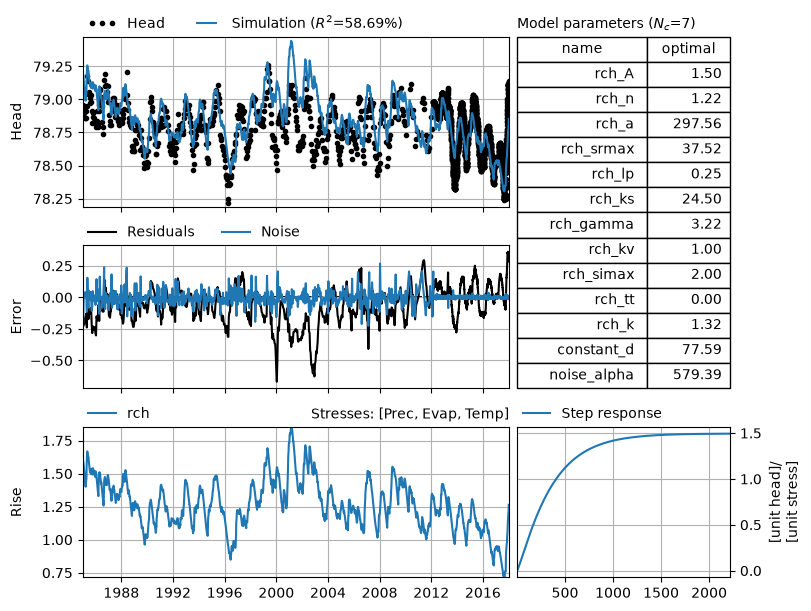
Finally, another nice bonus when using caching is that the optimal solution is already stored, meaning any calls to functions in which the optimal solution is needed (e.g. plotting) will be extra fast.

ml.plots.results();
Important Notes#

Cache Performance: The cache uses exact floating-point comparison for parameter values. During optimization, minor variations in parameter values (e.g., 1.0000000001 vs 1.0) create separate cache entries.

In normal workflows where you create a model, solve it, and use the results, cache invalidation is not an issue.

Temporarily enabling or disabling caching#

For operations where you know caching won’t help, you can temporarily disable caching using the context manager:

with ps.temporarily_disable_cache():
    # Caching is disabled here
    print(f"Caching is temporarily:  {'enabled' if ps.get_use_cache() else 'disabled'}")
    params = ml.get_parameters()
    result = ml.simulate(params)

# Caching is automatically re-enabled after the block
print(f"Cache is now: {'enabled' if ps.get_use_cache() else 'disabled'}")

Or if you wish to temporarily enable caching:

ps.set_use_cache(False)  # turn off caching

with ps.temporarily_enable_cache():
    # Caching is enable here
    print(f"Caching is temporarily:  {'enabled' if ps.get_use_cache() else 'disabled'}")
    params = ml.get_parameters()
    result = ml.simulate(params)

# Caching is automatically re-enabled after the block
print(f"Cache is now: {'enabled' if ps.get_use_cache() else 'disabled'}")