
Non-linear recharge models#
R.A. Collenteur, University of Graz
This notebook explains the use of the RechargeModel stress model to simulate the combined effect of precipitation and potential evaporation on the groundwater levels. For the computation of the groundwater recharge, four recharge models are currently available:
Berendrecht(Berendrecht et al., 2006)FlexModel(Collenteur et al., 2021)Peterson(Peterson & Western, 2014)
The first model is a simple linear function of precipitation and potential evaporation while the latter two are simulate a non-linear response of recharge to precipitation using a soil-water balance concepts. Detailed descriptions of these models can be found in articles listed in the References at the end of this notebook.
import matplotlib.pyplot as plt
import pandas as pd

import pastas as ps

ps.show_versions()
ps.set_log_level("INFO")
Pastas     : 2.0.0
Python     : 3.14.6
Numpy      : 2.4.6
Pandas     : 3.0.5
Scipy      : 1.18.0
Matplotlib : 3.11.1
Numba      : 0.66.0
Read Input data#
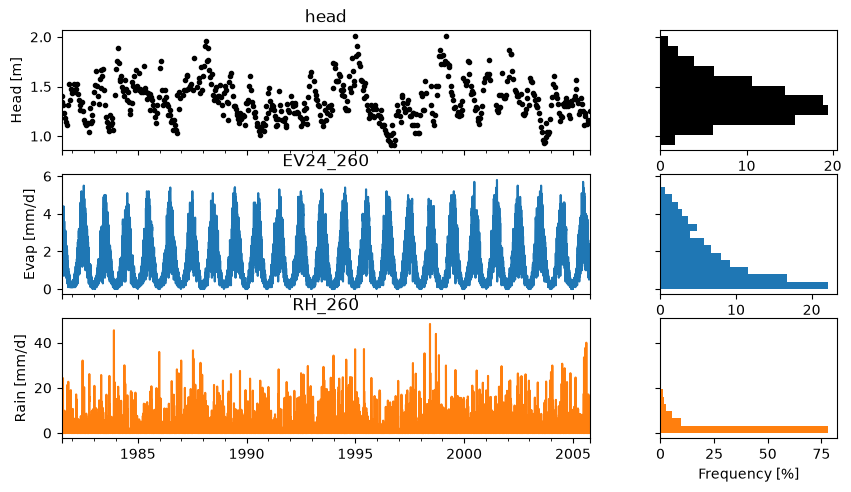
Input data handling is similar to other stressmodels. The only thing that is necessary to check is that the precipitation and evaporation are provided in mm/day. This is necessary because the parameters for the non-linear recharge models are defined in mm for the length unit and days for the time unit. It is possible to use other units, but this would require manually setting the initial values and parameter boundaries for the recharge models.
head = pd.read_csv(
    "data/B32C0639001.csv", parse_dates=["date"], index_col="date"
).squeeze()

# Make this millimeters per day
evap = pd.read_csv("data/evap_260.csv", index_col=0, parse_dates=[0]).squeeze()
rain = pd.read_csv("data/rain_260.csv", index_col=0, parse_dates=[0]).squeeze()

ps.plots.series(
    head,
    [evap, rain],
    figsize=(10, 6),
    labels=["Head [m]", "Evap [mm/d]", "Rain [mm/d]"],
);
Make a basic model#
The normal workflow may be used to create and calibrate the model.
Create a Pastas
ModelinstanceChoose a recharge model. All recharge models can be accessed through the recharge subpackage (
ps.rch).Create a
RechargeModelobject and add it to the modelSolve and visualize the model
ml = ps.Model(head)
ps.ArNoiseModel(model=ml)

# Select a recharge model
rch = ps.rch.FlexModel(gw_uptake=True)
# rch = ps.rch.Berendrecht()
# rch = ps.rch.Linear()
# rch = ps.rch.Peterson()

rm = ps.RechargeModel(ml, rain, evap, recharge=rch, rfunc=ps.Gamma(), name="rch")

ml.solve(tmin="1990", report="basic")
ml.plots.results(figsize=(10, 6));
---------------------------------------------------------------------------
KeyboardInterrupt                         Traceback (most recent call last)
Cell In[3], line 12
      8 # rch = ps.rch.Peterson()
      9
     10 rm = ps.RechargeModel(ml, rain, evap, recharge=rch, rfunc=ps.Gamma(), name="rch")
     11
---> 12 ml.solve(tmin="1990", report="basic")
     13 ml.plots.results(figsize=(10, 6));

File ~/checkouts/readthedocs.org/user_builds/pastas/envs/latest/lib/python3.14/site-packages/pastas/model.py:1017, in Model.solve(self, tmin, tmax, freq, warmup, solver, report, initial, weights, fit_constant, freq_obs, initialize, reset_settings, noise, **kwargs)
   1014     LeastSquares(model=self)
   1016 # Solve model
-> 1017 solve_success, result = self.solver.solve(weights=weights, **kwargs)
   1018 # Update the parameters with the results from the optimization
   1019 for column in result.columns:

File ~/checkouts/readthedocs.org/user_builds/pastas/envs/latest/lib/python3.14/site-packages/pastas/solver/least_squares.py:830, in LeastSquares.solve(self, weights, **kwargs)
    815     bounds = Bounds(
    816         lb=pmin,
    817         ub=pmax,
    818         keep_feasible=True,
    819     )
    821 objfunction = partial(
    822     self.objfunction,
    823     noise=noise,
   (...)    827     callback=kwargs.pop("callback", None),
    828 )
--> 830 self.result = least_squares(
    831     fun=objfunction,
    832     x0=initial[vary],
    833     jac=self.jac,
    834     bounds=bounds,
    835     method=self.method,
    836     ftol=self.ftol,
    837     xtol=self.xtol,
    838     gtol=self.gtol,
    839     x_scale=self.x_scale,
    840     loss=self.loss,
    841     f_scale=self.f_scale,
    842     max_nfev=self.max_nfev,
    843     diff_step=self.diff_step,
    844     tr_solver=self.tr_solver,
    845     **kwargs,
    846 )
    848 self.pcov = DataFrame(
    849     self.get_covariances(
    850         self.result.jac,
   (...)    856     columns=parameters.index,
    857 )
    859 # Prepare return values

File ~/checkouts/readthedocs.org/user_builds/pastas/envs/latest/lib/python3.14/site-packages/scipy/_lib/_util.py:660, in _workers_wrapper.<locals>.inner(*args, **kwds)
    658 with MapWrapper(_workers) as mf:
    659     kwargs['workers'] = mf
--> 660     return func(*args, **kwargs)

File ~/checkouts/readthedocs.org/user_builds/pastas/envs/latest/lib/python3.14/site-packages/scipy/optimize/_lsq/least_squares.py:1019, in least_squares(fun, x0, jac, bounds, method, ftol, xtol, gtol, x_scale, loss, f_scale, diff_step, tr_solver, tr_options, jac_sparsity, max_nfev, verbose, args, kwargs, callback, workers)
   1015     result = call_minpack(vector_fun.fun, x0, vector_fun.jac, ftol, xtol, gtol,
   1016                           max_nfev, x_scale, jac_method=jac)
   1018 elif method == 'trf':
-> 1019     result = trf(vector_fun.fun, vector_fun.jac, x0, f0, J0, lb, ub, ftol, xtol,
   1020                  gtol, max_nfev, x_scale, loss_function, tr_solver,
   1021                  tr_options.copy(), verbose, callback=callback_wrapped)
   1023 elif method == 'dogbox':
   1024     if tr_solver == 'lsmr' and 'regularize' in tr_options:

File ~/checkouts/readthedocs.org/user_builds/pastas/envs/latest/lib/python3.14/site-packages/scipy/optimize/_lsq/trf.py:124, in trf(fun, jac, x0, f0, J0, lb, ub, ftol, xtol, gtol, max_nfev, x_scale, loss_function, tr_solver, tr_options, verbose, callback)
    120     return trf_no_bounds(
    121         fun, jac, x0, f0, J0, ftol, xtol, gtol, max_nfev, x_scale,
    122         loss_function, tr_solver, tr_options, verbose, callback=callback)
    123 else:
--> 124     return trf_bounds(
    125         fun, jac, x0, f0, J0, lb, ub, ftol, xtol, gtol, max_nfev, x_scale,
    126         loss_function, tr_solver, tr_options, verbose, callback=callback)

File ~/checkouts/readthedocs.org/user_builds/pastas/envs/latest/lib/python3.14/site-packages/scipy/optimize/_lsq/trf.py:376, in trf_bounds(fun, jac, x0, f0, J0, lb, ub, ftol, xtol, gtol, max_nfev, x_scale, loss_function, tr_solver, tr_options, verbose, callback)
    372 f_true = f.copy()
    374 cost = cost_new
--> 376 J = jac(x)
    377 njev += 1
    379 if loss_function is not None:

File ~/checkouts/readthedocs.org/user_builds/pastas/envs/latest/lib/python3.14/site-packages/scipy/optimize/_differentiable_functions.py:750, in VectorFunction.jac(self, x)
    748 def jac(self, x):
    749     self._update_x(x)
--> 750     self._update_jac()
    751     if hasattr(self.J, "astype"):
    752         # returns a copy so that downstream can't overwrite the
    753         # internal attribute. But one can't copy a LinearOperator
    754         return self.J.astype(self.J.dtype)

File ~/checkouts/readthedocs.org/user_builds/pastas/envs/latest/lib/python3.14/site-packages/scipy/optimize/_differentiable_functions.py:719, in VectorFunction._update_jac(self)
    716 else:
    717     self._njev += 1
--> 719 self.J = self.jac_wrapped(xp_copy(self.x), f0=self.f)
    720 self.J_updated = True

File ~/checkouts/readthedocs.org/user_builds/pastas/envs/latest/lib/python3.14/site-packages/scipy/optimize/_differentiable_functions.py:454, in _VectorJacWrapper.__call__(self, x, f0, **kwds)
    452     self.njev += 1
    453 elif self.jac in FD_METHODS:
--> 454     J, dct = approx_derivative(
    455         self.fun,
    456         x,
    457         f0=f0,
    458         **self.finite_diff_options,
    459     )
    460     self.nfev += dct['nfev']
    462 if self.sparse_jacobian:

File ~/checkouts/readthedocs.org/user_builds/pastas/envs/latest/lib/python3.14/site-packages/scipy/optimize/_numdiff.py:611, in approx_derivative(fun, x0, method, rel_step, abs_step, f0, bounds, sparsity, as_linear_operator, args, kwargs, full_output, workers)
    609 with MapWrapper(workers) as mf:
    610     if sparsity is None:
--> 611         J, _nfev = _dense_difference(fun_wrapped, x0, f0, h,
    612                                  use_one_sided, method,
    613                                  mf)
    614     else:
    615         if not issparse(sparsity) and len(sparsity) == 2:

File ~/checkouts/readthedocs.org/user_builds/pastas/envs/latest/lib/python3.14/site-packages/scipy/optimize/_numdiff.py:738, in _dense_difference(fun, x0, f0, h, use_one_sided, method, workers)
    735 l = next(gen)
    736 u = next(gen)
--> 738 f1 = next(f_evals)
    739 f2 = next(f_evals)
    740 if one_sided:

File ~/checkouts/readthedocs.org/user_builds/pastas/envs/latest/lib/python3.14/site-packages/scipy/optimize/_numdiff.py:912, in _Fun_Wrapper.__call__(self, x)
    909 if xp.isdtype(x.dtype, "real floating"):
    910     x = xp.astype(x, self.x0.dtype)
--> 912 f = np.atleast_1d(self.fun(x, *self.args, **self.kwargs))
    913 if f.ndim > 1:
    914     raise RuntimeError("`fun` return value has "
    915                        "more than 1 dimension.")

File ~/checkouts/readthedocs.org/user_builds/pastas/envs/latest/lib/python3.14/site-packages/scipy/optimize/_differentiable_functions.py:424, in _VectorFunWrapper.__call__(self, x)
    422 def __call__(self, x):
    423     self.nfev += 1
--> 424     return np.atleast_1d(self.fun(x))

File ~/checkouts/readthedocs.org/user_builds/pastas/envs/latest/lib/python3.14/site-packages/scipy/optimize/_lsq/least_squares.py:263, in _WrapArgsKwargs.__call__(self, x)
    262 def __call__(self, x):
--> 263     return self.f(x, *self.args, **self.kwargs)

File ~/checkouts/readthedocs.org/user_builds/pastas/envs/latest/lib/python3.14/site-packages/pastas/solver/least_squares.py:772, in LeastSquares.objfunction(self, p, noise, weights, initial, vary, callback)
    770 par = initial
    771 par[vary] = p
--> 772 return misfit(
    773     ml=self.model, p=par, noise=noise, weights=weights, callback=callback
    774 )

File ~/checkouts/readthedocs.org/user_builds/pastas/envs/latest/lib/python3.14/site-packages/pastas/solver/objective_function.py:43, in misfit(ml, p, noise, weights, callback, returnseparate)
     41 # Get the residuals or the noise
     42 if noise:
---> 43     rv = ml.noise(p) * ml._noise_weights(p)
     44 else:
     45     rv = ml.residuals(p)

File ~/checkouts/readthedocs.org/user_builds/pastas/envs/latest/lib/python3.14/site-packages/pastas/model.py:706, in Model.noise(self, p, tmin, tmax, freq, warmup)
    703     p = self.get_parameters()
    705 # Calculate the residuals
--> 706 res = self.residuals(p, tmin, tmax, freq, warmup)
    707 p = p[-self.noisemodel.nparam :]
    709 # Calculate the noise

File ~/checkouts/readthedocs.org/user_builds/pastas/envs/latest/lib/python3.14/site-packages/pastas/model.py:611, in Model.residuals(self, p, tmin, tmax, freq, warmup)
    606 freq_obs = (
    607     freq if self.settings["freq_obs"] is None else self.settings["freq_obs"]
    608 )
    610 # simulate model
--> 611 sim = self.simulate(
    612     p=p, tmin=tmin, tmax=tmax, freq=freq, warmup=warmup, return_warmup=False
    613 )
    615 # Get the oseries calibration series
    616 obs = self.observations(tmin=tmin, tmax=tmax, freq=freq_obs)

File ~/checkouts/readthedocs.org/user_builds/pastas/envs/latest/lib/python3.14/site-packages/pastas/model.py:509, in Model.simulate(self, p, tmin, tmax, freq, warmup, return_warmup)
    501 # Get the simulation index and the time step
    502 # Check if the requested index matches the model settings
    503 if (
    504     tmin == self.settings["tmin"]
    505     and tmax == self.settings["tmax"]
    506     and freq == self.settings["freq"]
    507     and warmup == self.settings["warmup"]
    508 ):
--> 509     sim_index = self.sim_index
    510 else:
    511     # simulate with the requested settings, but do not update
    512     # the model settings, since this is just for one time
    513     sim_index = _get_sim_index(
    514         tmin=tmin - warmup,
    515         tmax=tmax,
    516         freq=freq,
    517         time_offset=self.time_offset,
    518     )

File ~/checkouts/readthedocs.org/user_builds/pastas/envs/latest/lib/python3.14/site-packages/pastas/model.py:1389, in Model.sim_index(self)
   1371 @property
   1372 def sim_index(self) -> DatetimeIndex:
   1373     """Property that returns the simulation index, including the warmup.
   1374
   1375     Using the tmin, tmax, freq, and warmup from the model
   (...)   1383         model is simulated.
   1384     """
   1385     return _get_sim_index(
   1386         tmin=self.settings["tmin"] - self.settings["warmup"],
   1387         tmax=self.settings["tmax"],
   1388         freq=self.settings["freq"],
-> 1389         time_offset=self.time_offset,
   1390     )

File ~/checkouts/readthedocs.org/user_builds/pastas/envs/latest/lib/python3.14/site-packages/pastas/model.py:1358, in Model.time_offset(self)
   1355 if st.freq_original:
   1356     # calculate the offset from the default frequency
   1357     t = st.series_original.index
-> 1358     base = t.min().ceil(freq)
   1359     mask = t >= base
   1360     if np.any(mask):

File pandas/_libs/tslibs/timestamps.pyx:3082, in pandas._libs.tslibs.timestamps.Timestamp.ceil()
-> 3082 'Could not get source, probably due dynamically evaluated source code.'

File pandas/_libs/tslibs/timestamps.pyx:2754, in pandas._libs.tslibs.timestamps.Timestamp._round()
-> 2754 'Could not get source, probably due dynamically evaluated source code.'

File pandas/_libs/tslibs/offsets.pyx:6362, in pandas._libs.tslibs.offsets.to_offset()
-> 6362 'Could not get source, probably due dynamically evaluated source code.'

File pandas/_libs/tslibs/offsets.pyx:1288, in pandas._libs.tslibs.offsets.Tick.__mul__()
-> 1288 'Could not get source, probably due dynamically evaluated source code.'

File ~/checkouts/readthedocs.org/user_builds/pastas/envs/latest/lib/python3.14/site-packages/numpy/_core/numeric.py:2494, in isclose(a, b, rtol, atol, equal_nan)
   2491     y = float(y)
   2493 # atol and rtol can be arrays
-> 2494 if not (np.all(np.isfinite(atol)) and np.all(np.isfinite(rtol))):
   2495     err_s = np.geterr()["invalid"]
   2496     err_msg = f"One of rtol or atol is not valid, atol: {atol}, rtol: {rtol}"

File ~/checkouts/readthedocs.org/user_builds/pastas/envs/latest/lib/python3.14/site-packages/numpy/_core/fromnumeric.py:2634, in all(a, axis, out, keepdims, where)
   2548 @array_function_dispatch(_all_dispatcher)
   2549 def all(a, axis=None, out=None, keepdims=np._NoValue, *, where=np._NoValue):
   2550     """
   2551     Test whether all array elements along a given axis evaluate to True.
   2552
   (...)   2632
   2633     """
-> 2634     return _wrapreduction_any_all(a, np.logical_and, 'all', axis, out,
   2635                                   keepdims=keepdims, where=where)

File ~/checkouts/readthedocs.org/user_builds/pastas/envs/latest/lib/python3.14/site-packages/numpy/_core/fromnumeric.py:97, in _wrapreduction_any_all(obj, ufunc, method, axis, out, **kwargs)
     95         pass
     96     else:
---> 97         return reduction(axis=axis, out=out, **passkwargs)
     99 return ufunc.reduce(obj, axis, bool, out, **passkwargs)

File ~/checkouts/readthedocs.org/user_builds/pastas/envs/latest/lib/python3.14/site-packages/numpy/_core/_methods.py:70, in _all(a, axis, dtype, out, keepdims, where)
     68 # Parsing keyword arguments is currently fairly slow, so avoid it for now
     69 if where is True:
---> 70     return umr_all(a, axis, dtype, out, keepdims)
     71 return umr_all(a, axis, dtype, out, keepdims, where=where)

KeyboardInterrupt:
Analyze the estimated recharge flux#
After the parameter estimation we can take a look at the recharge flux computed by the model. The flux is easy to obtain using the get_stress method of the model object, which automatically provides the optimal parameter values that were just estimated. After this, we can for example look at the yearly recharge flux estimated by the Pastas model.
recharge = ml.get_stress("rch").resample("YE").sum()
ax = recharge.plot.bar(figsize=(10, 3))
ax.set_xticklabels(recharge.index.year)
plt.ylabel("Recharge [mm/year]");
A few things to keep in mind:#
Below are a few things to keep in mind while using the (non-linear) recharge models.
The use of an appropriate warmup period is necessary, so make sure the precipitation and evaporation are available some time (e.g., one year) before the calibration period.
Make sure that the units of the precipitation fluxes are in mm/day and that the DatetimeIndex matches exactly.
It may be possible to fix or vary certain parameters, dependent on the problem. Obtaining better initial parameters may be possible by solving without a noise model first and then solve it again using a noise model.
For relatively shallow groundwater levels (e.g., < 10 meters), it may be better to use the
Exponentialresponse function as the the non-linear models already cause a delayed response.
References#
Berendrecht, W. L., Heemink, A. W., van Geer, F. C., and Gehrels, J. C. (2003), Decoupling of modeling and measuring interval in groundwater time series analysis based on response characteristics, Journal of Hydrology, 278, 1–16.
Berendrecht, W. L., Heemink, A. W., van Geer, F. C., and Gehrels, J. C. (2006), A non-linear state space approach to model groundwater fluctuations, Advances in Water Resources, 29, 959–973.
Collenteur, R. A., Bakker, M., Klammler, G., and Birk, S. (2021), Estimation of groundwater recharge from groundwater levels using nonlinear transfer function noise models and comparison to lysimeter data, Hydrol. Earth Syst. Sci., 25, 2931–2949.
Peterson, T.J., and A.W. Western (2014), Nonlinear time-series modeling of unconfined groundwater head, Water Resour. Res., 50, 8330-8355.
Von Asmuth, J.R., Maas, K., Bakker, M. and Petersen, J. (2008), Modeling Time Series of Ground Water Head Fluctuations Subjected to Multiple Stresses. Groundwater, 46: 30-40.
Data Sources#
In this notebook we analysed a head time series near the town of De Bilt in the Netherlands. Data is obtained from the following resources:
The heads (
B32C0639001.csv) are downloaded from https://www.dinoloket.nl/The precipitation and evapotranspiration (
rain_260.csvandevap_260.csv) are downloaded from https://knmi.nl